How Predictive Analytics, Customer Intelligence, and Market Intelligence Drive Smarter Business Decisions
The best business decisions come from anticipating market shifts, understanding customers, and turning data into actionable intelligence.
By

Subsig Team

Businesses generate enormous amounts of data from transactions, marketing, and market activity, and now from a channel that barely existed a few years ago: what AI answer engines say about them when someone asks a question instead of typing a search. Understanding what already happened still matters, but competitive organizations now focus on predicting what happens next, for a customer, a market, or the accuracy of an AI-generated answer describing their business. That is the intersection Subsig works in daily, built on three connected disciplines: Predictive Analytics, Customer Intelligence, and Market Intelligence, which together help organizations anticipate behavior, spot opportunity, and make sure the story AI tells about them is correct.
Why forward-looking intelligence matters
Customer expectations shift quickly, and conditions change without warning. Organizations constantly face the same questions:
Which customers are likely to convert or churn?
What products will see rising demand?
Which markets offer the strongest growth?
Does the AI's answer actually describe the business correctly?
Reporting explains the past. Intelligence explains what is coming.
Understanding predictive analytics
What would change if a business could see a cancellation coming three weeks before the customer clicked cancel?
Predictive Analytics uses historical data, statistical models, and behavioral signals to forecast outcomes rather than just report on them, turning scattered signals into a single score a team can act on.
A subscription business notices that customers who stop opening onboarding emails in week two cancel at nearly four times the normal rate, and intervenes before cancellation instead of after. A B2B vendor ranks leads by predicted close probability instead of source, and finds a mid-tier list converts better than its priciest channel.
Metrics worth tracking:
Churn probability: likelihood of cancellation, guides retention effort
Revenue forecast: expected revenue, supports planning
Lead score: likelihood of conversion, focuses sales effort
Demand forecast: predicted demand improves inventory and staffing
Customer lifetime value prediction: projected future value, guides acquisition spend
Every forecast is a hypothesis wearing a decimal point.
Salesforce applies scoring directly inside a CRM; Tableau is often used to visualize the resulting forecasts.
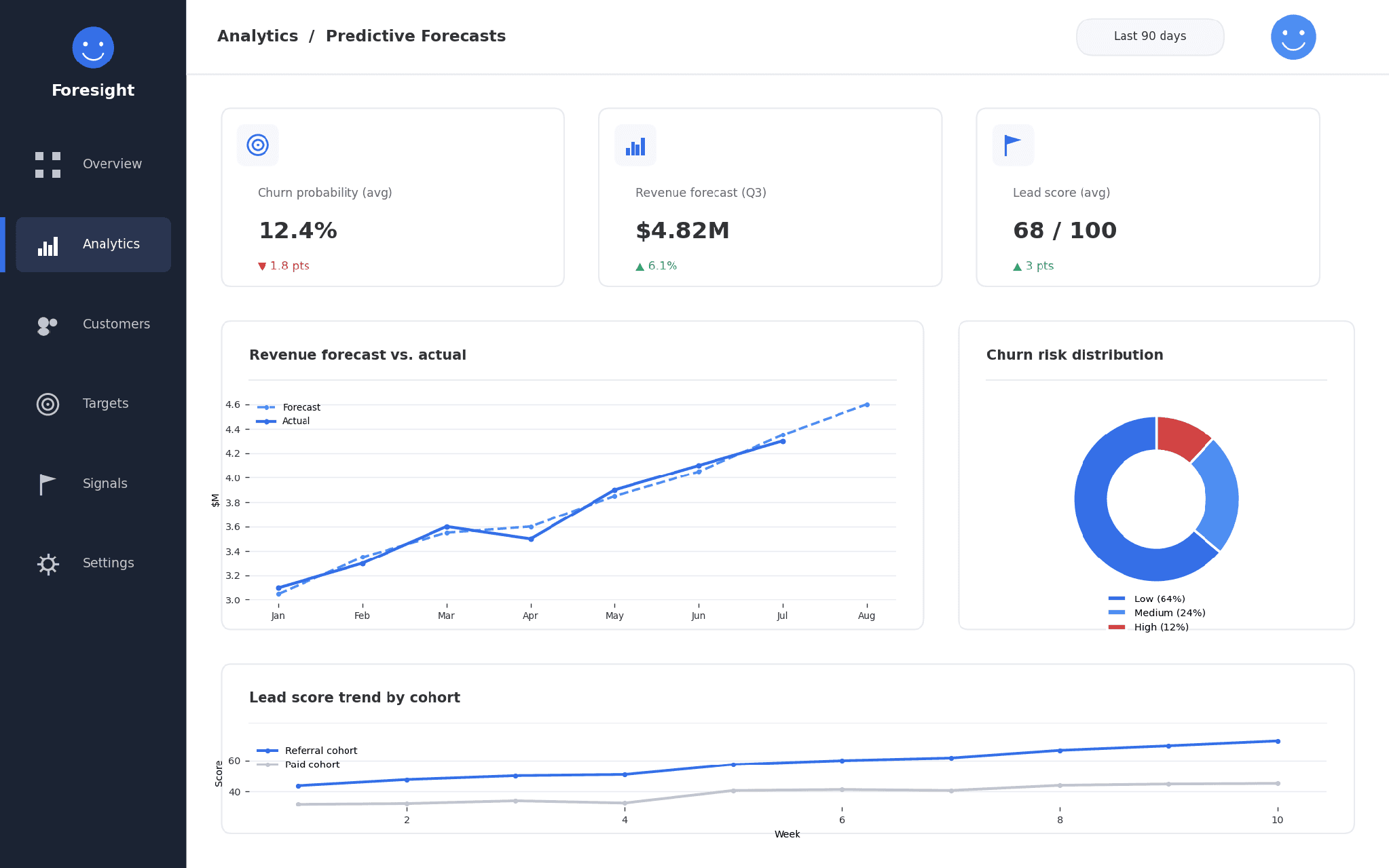
A predictive analytics dashboard: revenue forecast vs. actual, churn risk distribution, and lead score trend by cohort.
How customer intelligence improves decision-making
Customers rarely churn for one reason. They usually churn for three reasons that happen to arrive at once.
That is the case for treating an audience as distinct people rather than a single average. Customer Intelligence studies behavior, preferences, and engagement to explain why customers act the way predictive models say they will.
An ecommerce brand finds that repeat customers who read its educational content have nearly three times the lifetime value of customers acquired through discount codes, a segment that a churn score alone would never surface. A media subscription service finds that subscribers who install its app in week one retain far longer than desktop-only subscribers.
Metrics worth tracking:
Customer lifetime value: long-term value, supports growth planning
Retention rate: percentage of returning customers, measures loyalty
Engagement score: quality of interaction, flags active or at-risk users
Segmentation depth: distinctness of audience groups improves personalization
Purchase frequency: repeat buying behavior supports revenue growth
HubSpot and Mixpanel are common ways to track these patterns across the customer journey.
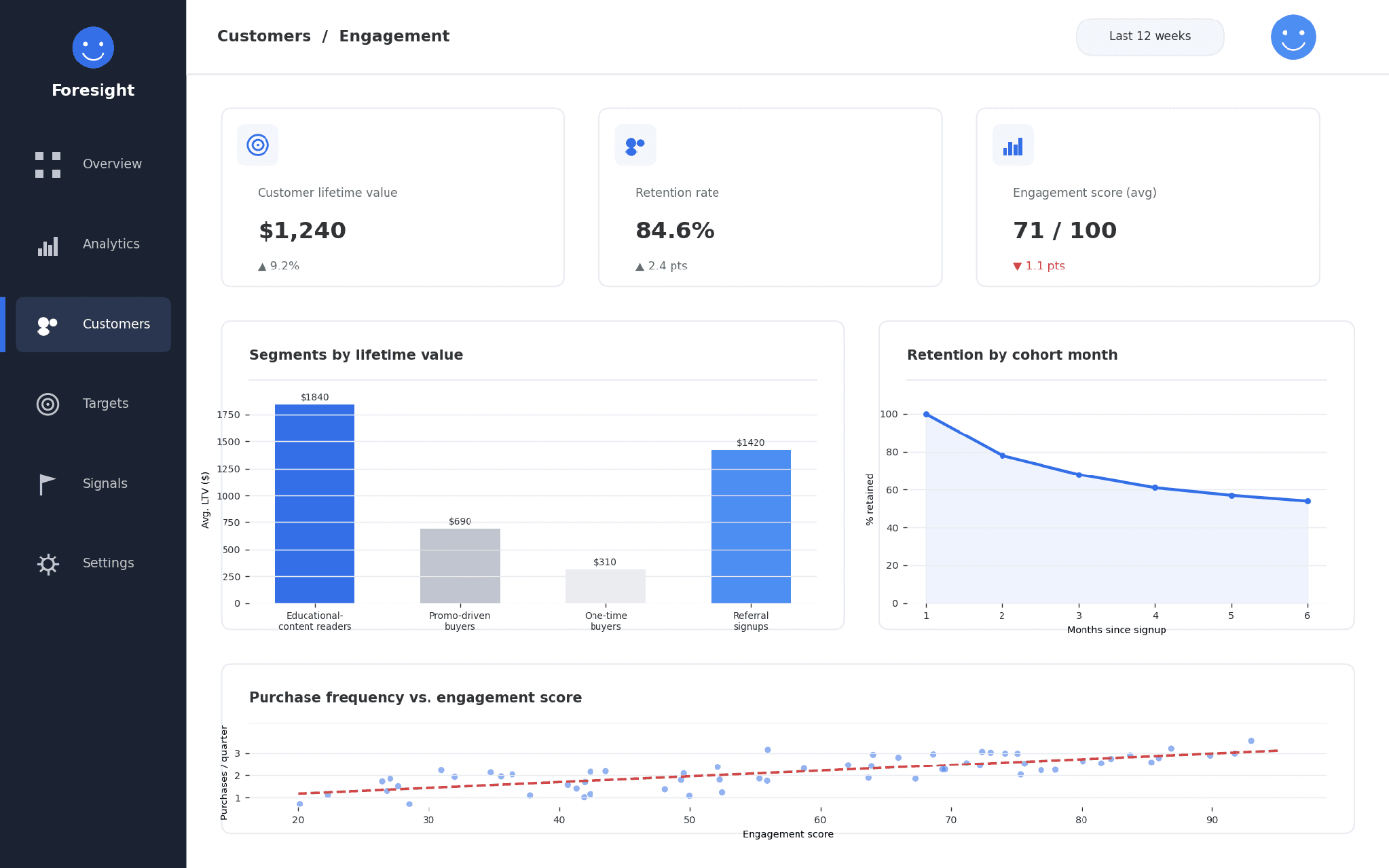
A customer intelligence dashboard: segments by lifetime value, retention by cohort, and purchase frequency vs. engagement.
Why market intelligence is essential
Customer Intelligence looks inward, at the people already inside a business's world. Market Intelligence looks outward, at everyone else.
Where predictive analytics forecasts and customer intelligence explains, market intelligence watches competitors, industry shifts, and demand signals from outside the business. A vendor that studies only its own users can still be blindsided by a competitor's launch.
A project management vendor tracks rising demand for “AI-powered workflow” tools six months before competitors reposition around the phrase, gaining a head start. A regional retailer sees a competitor's share of voice climbing in local search and moves up a planned renovation before losing more ground.
Metrics worth tracking:
Market share: competitive position by revenue or usage
Share of voice: brand visibility versus competitors, including in AI-generated answers
Trend velocity: how fast a demand signal is accelerating
Competitive activity: frequency and type of competitor moves
Demand indicators: overall market interest, guides investment timing
The market does not wait for a quarterly review.
Similarweb and Semrush are common ways to monitor these shifts.
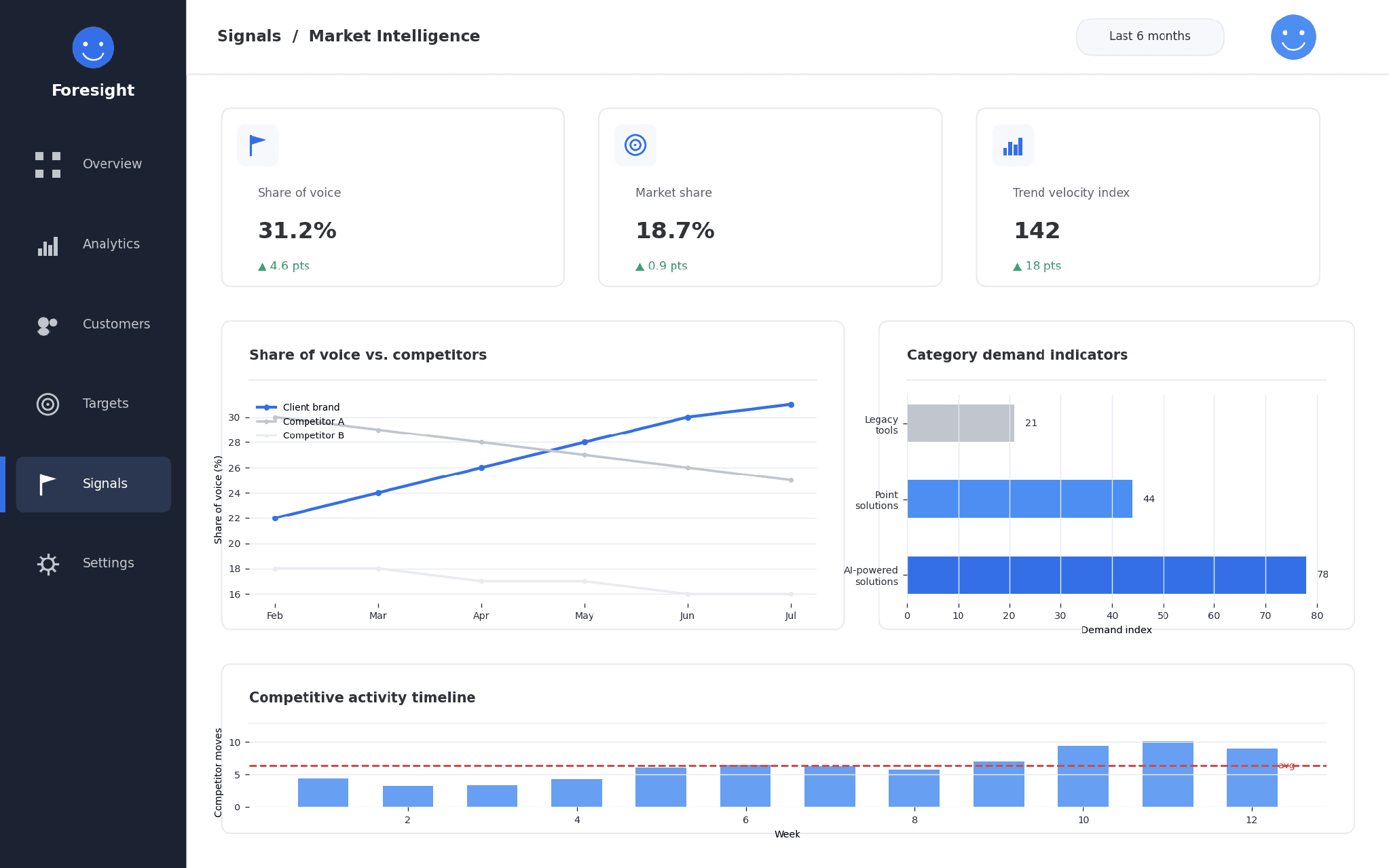
A market intelligence dashboard: share of voice vs. competitors, category demand, and competitive activity.
Comparing the three disciplines
A single-lens answer is usually a half answer.
Each discipline answers a different question:
Predictive Analytics: What is likely to happen next
Customer Intelligence: why customers behave the way they do
Market Intelligence: What is changing outside the business
Used alone, each gives a partial picture. Used together, they triangulate one answer instead of three guesses.
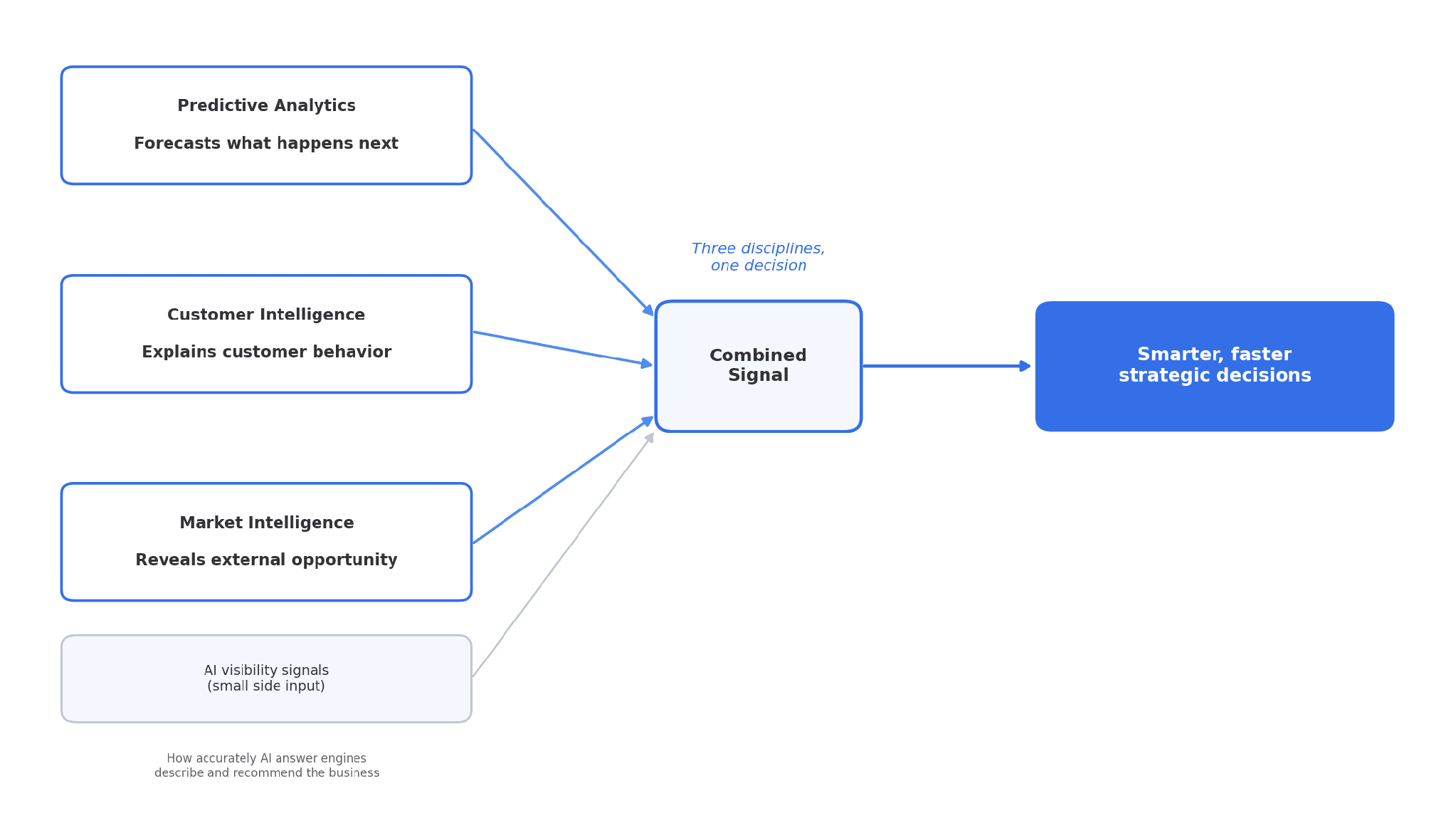
How the three disciplines, plus AI visibility as a smaller side input, feed into one combined decision.
Case study: the churn that no single discipline could explain
A mid-market SaaS company (anonymized) opened the quarter with churn at 11.8%, up from 6.9% two quarters earlier. Predictive Analytics had flagged the trend, forecasting churn would climb toward 12%, a forecast that proved almost exactly right, but the model could not say why.
Customer Intelligence added the next layer. Segmenting churned accounts showed 51% came from customers who had requested a specific integration in the past year, while price-sensitive accounts and onboarding stalls, the usual suspects, stayed flat at 22% and 27%.
Market Intelligence supplied the cause: a rival had shipped eight feature releases in twelve weeks, including that exact integration, while lifting its share of voice in the category by 9 points.
No single discipline found the root cause alone. Combined, it was clear: a competitor feature launch was pulling one customer segment, calling for a roadmap commitment and targeted outreach instead of a blanket discount.
Two quarters later:
Blended churn: 11.8% down to 6.1%
Feature-gap churn: 51% of total churn down to 19%
Net revenue retention: 88.5% to 96.4%
Share of voice versus the competitor: 25.6% up to 34.8%
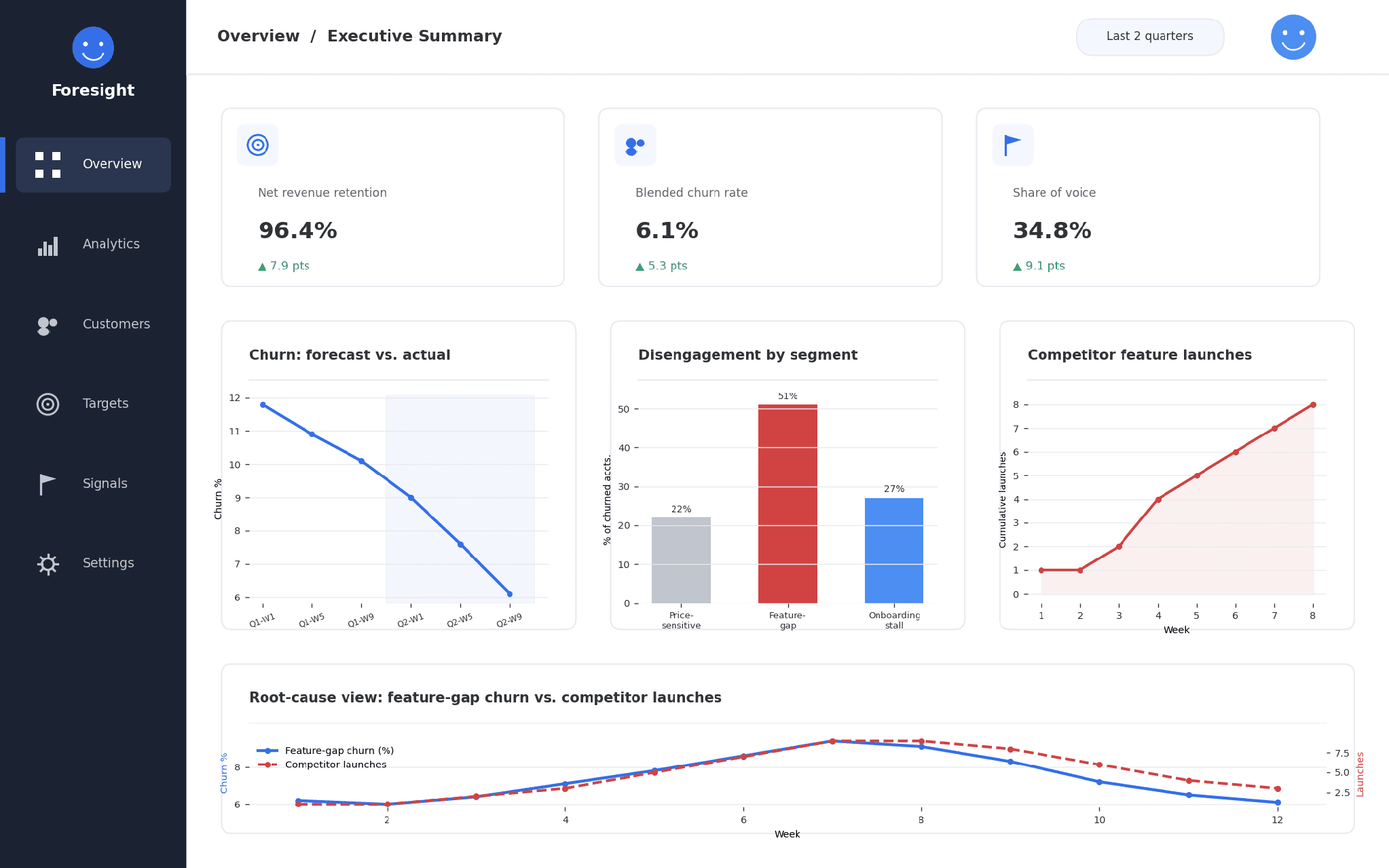
The combined view that connected feature-gap churn to a competitor's release cadence.
A shorter example: two signals, one fixed
An online education platform saw lead scores dip on a paid channel that had always performed well. Customer Intelligence traced it to a landing-page redesign that had quietly dropped a testimonials section three weeks earlier. Restoring it brought lead quality back within one reporting cycle: a predictive signal is a starting point, not an answer.
Common mistakes and how to avoid them
Treating a forecast as a decision. A churn prediction says risk is rising, not why or what to do; pair it with customer intelligence before acting.
Segmenting by demographics instead of behavior. Usage patterns predict cancellation better than age or industry ever will.
Watching competitors but not demand. Tracking a rival's release is useful; missing the demand shift behind it is not.
Ignoring AI visibility as a market signal. Visibility without accuracy is just being wrong, loudly, and it changes who even reaches the funnel.
Optimizing metrics that do not connect to revenue. Validate metrics against outcomes, not against each other.
Acting on one discipline in isolation. The case study above only revealed its cause once all three were combined.
Real-world applications
SaaS companies forecast churn, improve adoption, and catch positioning shifts early. E-commerce brands forecast demand and monitor competitor pricing to protect their margins. Subscription businesses combine retention modeling with personalization to keep subscribers longer. B2B organizations prioritize high-value prospects and track category demand before a deal reaches sales.
The next frontier: copilots, agents, and digital twins
AI is compressing the distance between noticing a pattern and acting on it:
AI copilots: assistants embedded in analytics tools that surface a forecast in plain language before anyone goes looking for it.
Conversational analytics: asking a dashboard why churn rose last month and getting a direct answer instead of building a new report.
Autonomous action: systems that trigger a retention offer or adjust a bid automatically, with a human reviewing the outcome rather than every step.
Multi-agent analytics: specialized AI agents, one watching customers, one watching competitors, one watching demand, comparing notes and surfacing one recommendation the way the case study above required a human team to assemble by hand.
Digital twins: live simulated models of a customer base or market that let a team test a pricing change before committing to it for real.
Organizations that adopt these capabilities early will not just report on change faster; they will feed it back into the market, including the AI systems now sitting between a business and its next customer.
A few lines worth remembering
Every forecast is a hypothesis wearing a decimal point.
Customers rarely churn for one reason. They usually churn for three reasons that happen to arrive at once.
The market does not wait for a quarterly review.
Visibility without accuracy is just being wrong, loudly.
A single-lens answer is usually a half answer.
Reporting explains the past. Intelligence explains what is coming.
Key takeaways
|
Conclusion
Predictive Analytics, Customer Intelligence, and Market Intelligence answer three different questions, and the businesses that grow fastest stop treating them as separate reports and start treating them as one system. The case study above did not need a bigger model or fancier dashboard; it needed all three lenses on the same problem at the same time.
That same logic now extends to AI visibility. An AI answer engine that misdescribes a business, or leaves it out of a recommendation, is a market signal exactly like a competitor's price cut. Organizations that build the habit of checking all four signals together, not just the three inside the business, will make faster decisions and will be the ones an AI system chooses to recommend in the first place.
Related Articles

AI Visibility

on
AI search in 2026: what's changed, and how businesses can adapt
Buyer research has moved onto AI platforms, and classic search clicks keep falling even as visibility grows. Most B2B brands remain invisible across the platforms their buyers now use. Here is what changed in 2026, and what adapting actually requires.

Brand Mention
on
How to choose the right prompts to track your AI visibility
Choosing the right prompts is the first step to tracking AI visibility effectively. Here are the five categories to cover, examples for each, and what a breakdown of visibility, sentiment, ranking, and sources actually reveals.
AI Visibility
on
SEO vs AEO: a building block, not a replacement
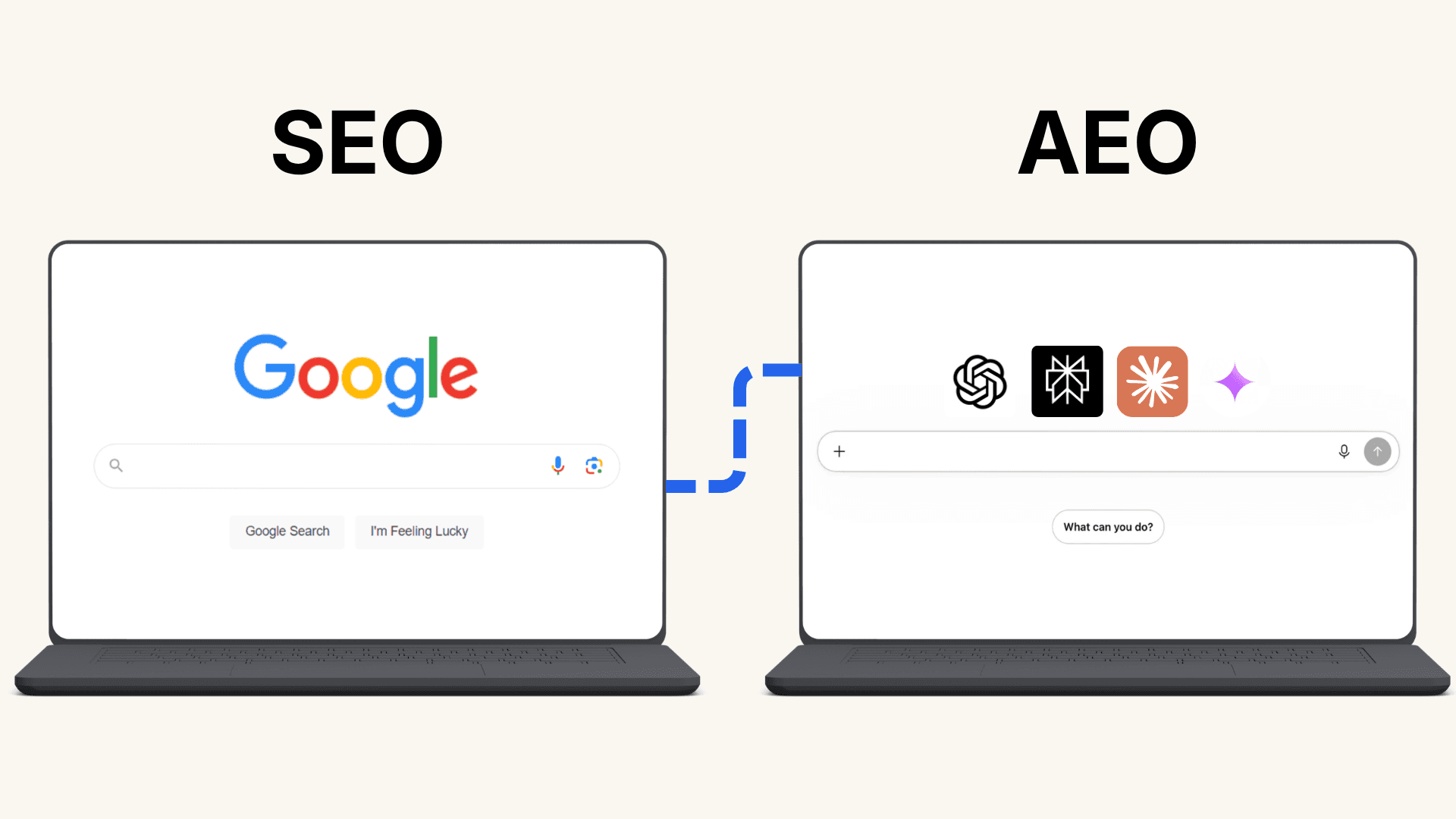
AEO can feel like a brand-new discipline to learn from scratch, right as clicks from Google search keep dropping. It isn't. AEO is built on the SEO fundamentals already in place, here's how the two actually work together.

AI Visibility
on
How online reviews improve AI visibility: why reviews matter
Online reviews give AI search tools more context about your brand by showing what real customers say about your products or services. Learn how reviews, reputation, and online mentions can support your AI visibility and help AI understand when your brand may be relevant.

AI Visibility
on
AI visibility: AI marketing that reaches decision makers
AI marketing isn't just content and ads anymore, it's how the buying committee actually finds you. Here's who's using ChatGPT, Perplexity, Claude, and Google AI Overview, and why missing even one of them can cost you the sale.

AI Visibility
on
August 2026 ranking dips explained: seasonal trends vs. AI visibility changes
Is your August ranking drop seasonal or AI related? Learn which SEO and AI visibility signals can help you find out.