How Brand Intelligence, Reputation Intelligence, and Social Intelligence Strengthen Business Growth
Business growth is shaped not only by what companies do, but also by how customers perceive, discuss, and trust their brands.
By
Subsig Team

Brands today are shaped by more than marketing budgets. Customer opinions, reviews, social conversations, and public sentiment now do as much to define a business as its own campaigns do.
Brand Intelligence, Reputation Intelligence, and Social Intelligence solve that problem as a set: one shows how a brand is perceived, one shows whether it is trusted, and one shows what people are actually saying about it right now. A fourth layer belongs in this mix from the first paragraph, not the last: AI visibility, how accurately AI search tools and answer engines describe a business to the people researching it before they ever form an opinion of their own.
A brand is no longer just what a company says about itself. It is what everyone else is saying while nobody from the company is in the room.
Technology matters less than most teams assume. A great listening platform does not fix a trust problem, and a strong response strategy beats a great tool with no strategy behind it.
Why intelligence matters in a connected world
A single customer experience can spread across social platforms, review sites, forums, news coverage, influencer channels, and video platforms within hours, often before a brand team even knows it happened.
Organizations frequently ask: how is our brand perceived online, what do customers think about our products, how does our reputation compare to competitors, and what emerging trends should we be watching? Traditional marketing reporting was never built to answer any of these in real time.
Forrester and Gartner have both flagged customer experience and reputation signals as leading indicators of revenue risk, often surfacing problems in the data well before they show up in churn or sales numbers. The businesses that watch these signals get a head start measured in weeks, not days.
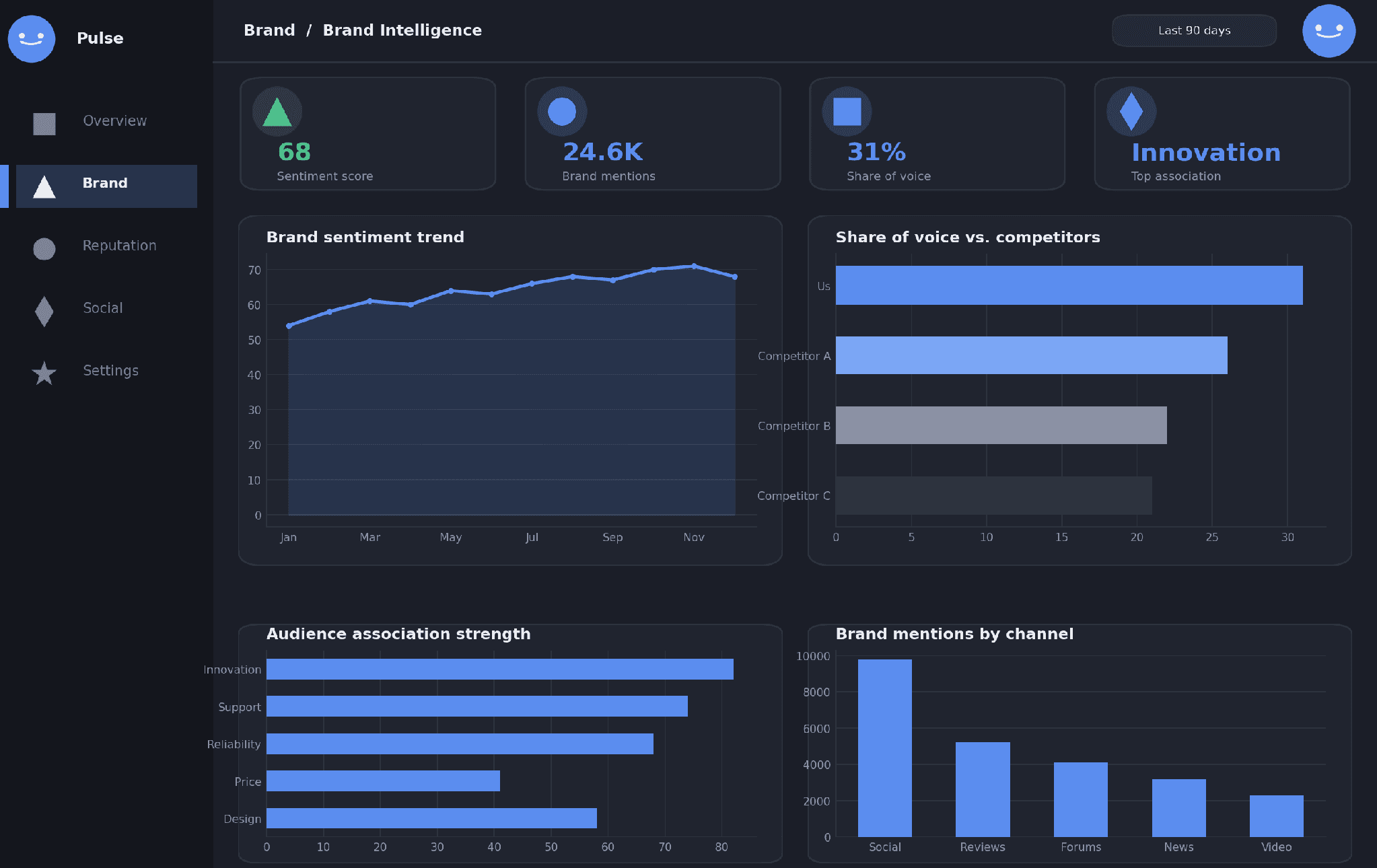
Brand intelligence dashboard displaying sentiment trends, brand mentions, audience engagement, and reputation metrics.
Understanding brand intelligence
Perception moves faster than a rebrand ever will.
Brand intelligence looks at how audiences perceive a brand and what shapes awareness, recognition, and trust, going beyond impressions and reach into what people actually associate with the name.
A software company discovers that audiences consistently associate its brand with innovation and support, while competitors are more strongly linked to price. That gap becomes the backbone of its next positioning campaign. A consumer goods brand finds that its packaging redesign shifted audience language from "cheap" to "accessible," a distinction that mattered enormously to how the brand could price its next product line.
Brand awareness - recognition within target audiences
Share of voice - visibility compared to competitors
Brand sentiment - audience perception, tracks brand health
Brand mentions - discussion volume across channels
Audience association - topics linked to the brand, strengthen positioning
A brand tracking dashboard that nobody uses to adjust messaging is just an expensive mirror. The value shows up only when a shift in association or sentiment actually changes a campaign brief.
How reputation intelligence protects trust
While brand intelligence tracks awareness and positioning, reputation intelligence tracks something narrower and more urgent: trust, credibility, and whether stakeholders still believe the brand will deliver.
A company can have strong brand awareness and a declining reputation at the same time, usually because service problems are eroding trust faster than marketing can build it. Reputation intelligence exists to catch that gap before it shows up in the churn numbers.
Reputation score - overall brand trust, measures public confidence
Review sentiment - customer feedback quality, identifies service issues
Media sentiment - tone of media coverage- protects brand reputation
Customer trust indicators - confidence in products and services, support retention
Crisis signals - emerging reputation risks, enable a proactive response
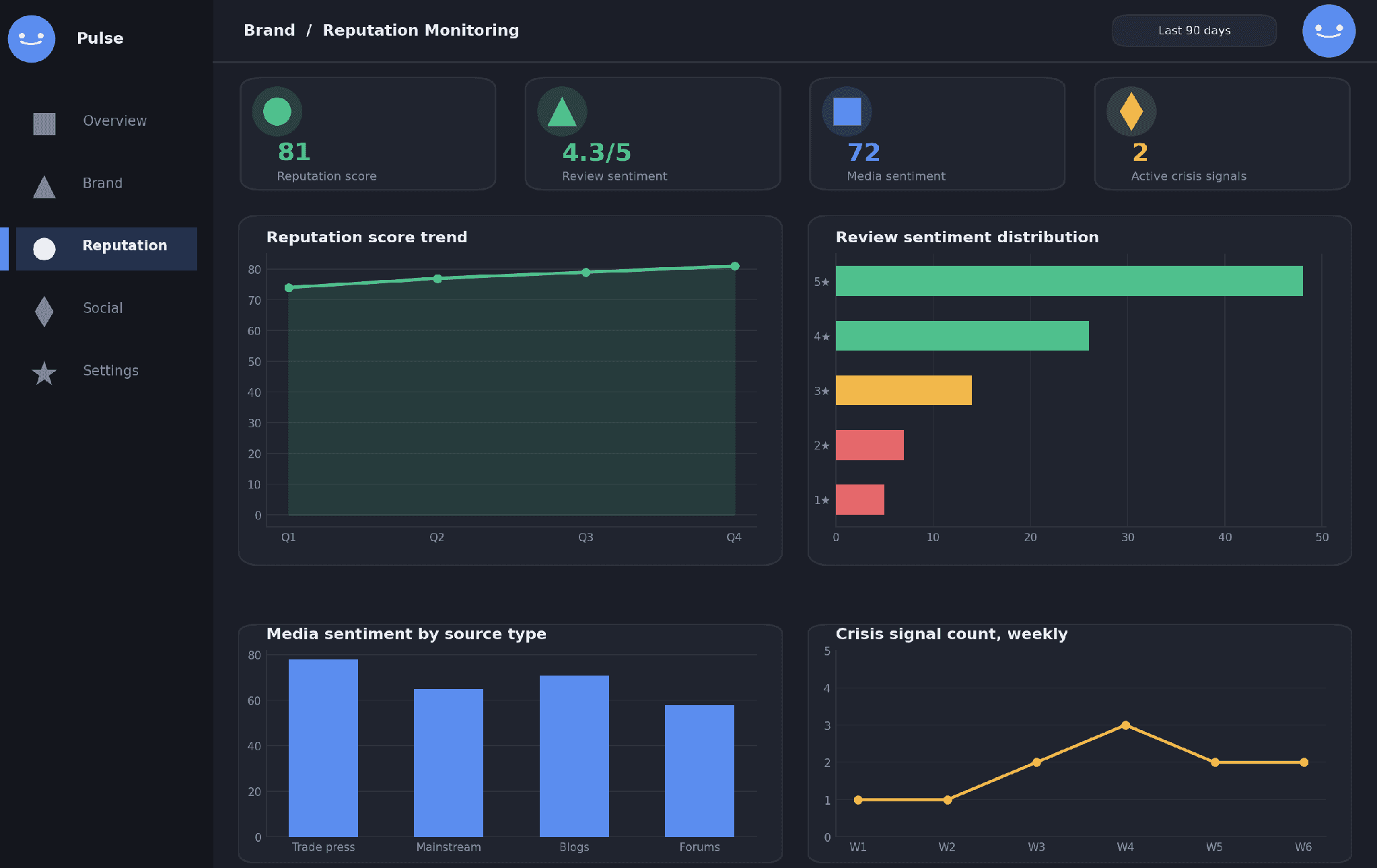
Reputation monitoring dashboard displaying review sentiment, media coverage, and trust indicators.
A five-star product with a two-star support experience is still a two-star brand to the people living through it.
Why social intelligence matters
Social intelligence analyzes conversations and behavior across platforms and digital communities, and it is often the earliest place a trend, complaint, or opportunity becomes visible, well before it reaches a survey or a review site.
A consumer brand spots an emerging product trend through TikTok discussions before competitors notice it. A B2B software company notices a wave of frustrated posts about a competitor's pricing change days before that competitor issues a public statement, and uses the window to run a targeted comparison campaign.
Social engagement - interaction with content, measures audience interest
Social sentiment - positive and negative reactions, evaluates perception
Conversation volume - discussion frequency, tracks awareness
Influencer mentions - brand references by creators, measures influence
Trending topics - emerging audience interests, support innovation
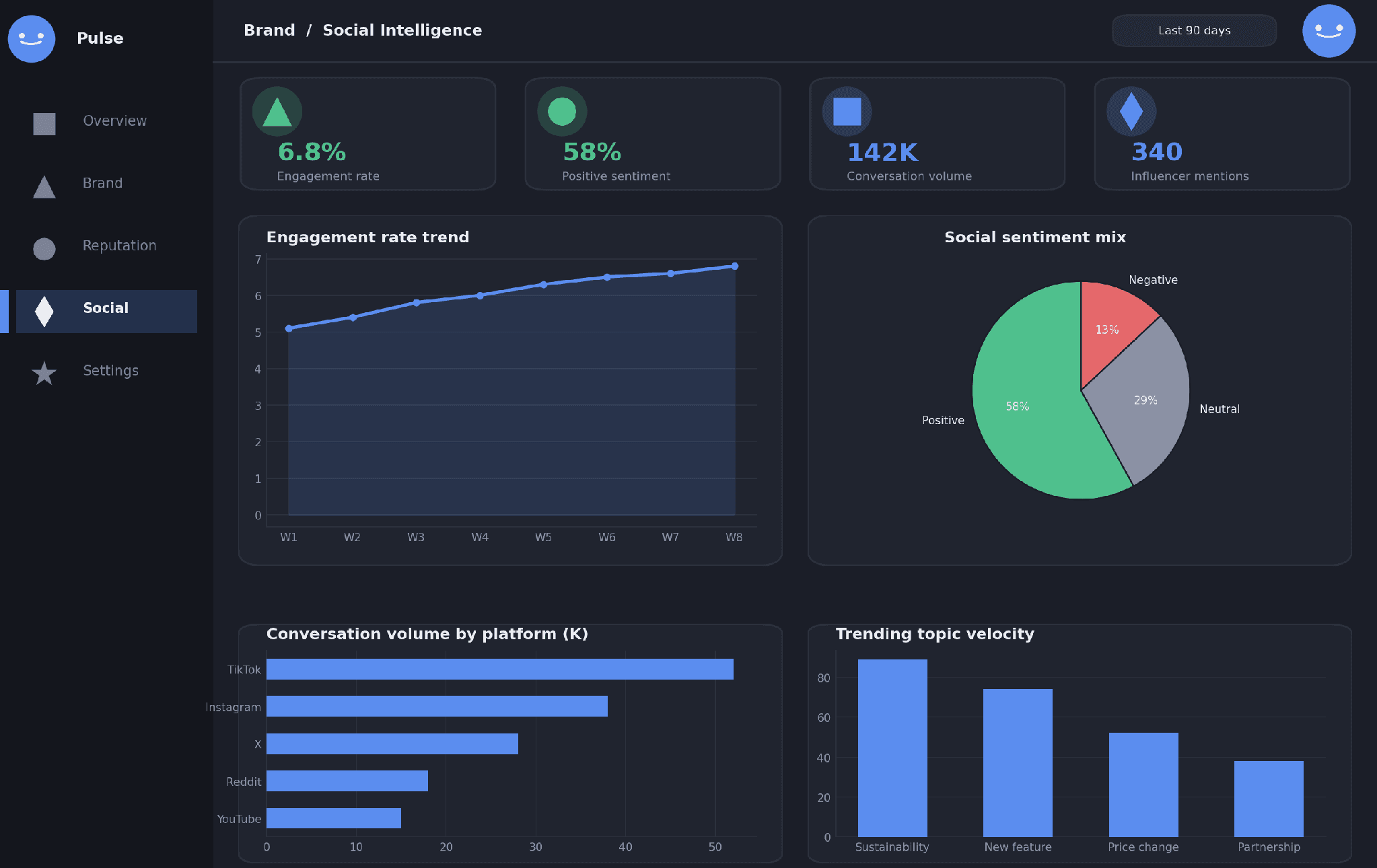
Social intelligence dashboard displaying engagement trends, audience sentiment, influencer activity, and trending topics.
Comparing the three disciplines
Brand Intelligence - perception and positioning. How is our brand viewed?
Reputation Intelligence - trust and credibility. What is our reputation?
Social Intelligence - conversations and behavior. What are people discussing?
Organizations get the most value when all three run together: brand intelligence explains perception, reputation intelligence measures trust, and social intelligence reveals the conversations driving both.
How the three connect
Think of this as one continuous read on audience relationship rather than three separate reports. Social intelligence surfaces the raw conversation. Reputation intelligence filters that conversation for trust signals and risk. Brand intelligence rolls into the broader question of how the market perceives the company. Increasingly, a fourth signal belongs in that same loop: how AI search tools and answer engines describe the brand to people who have not yet formed an opinion of their own.
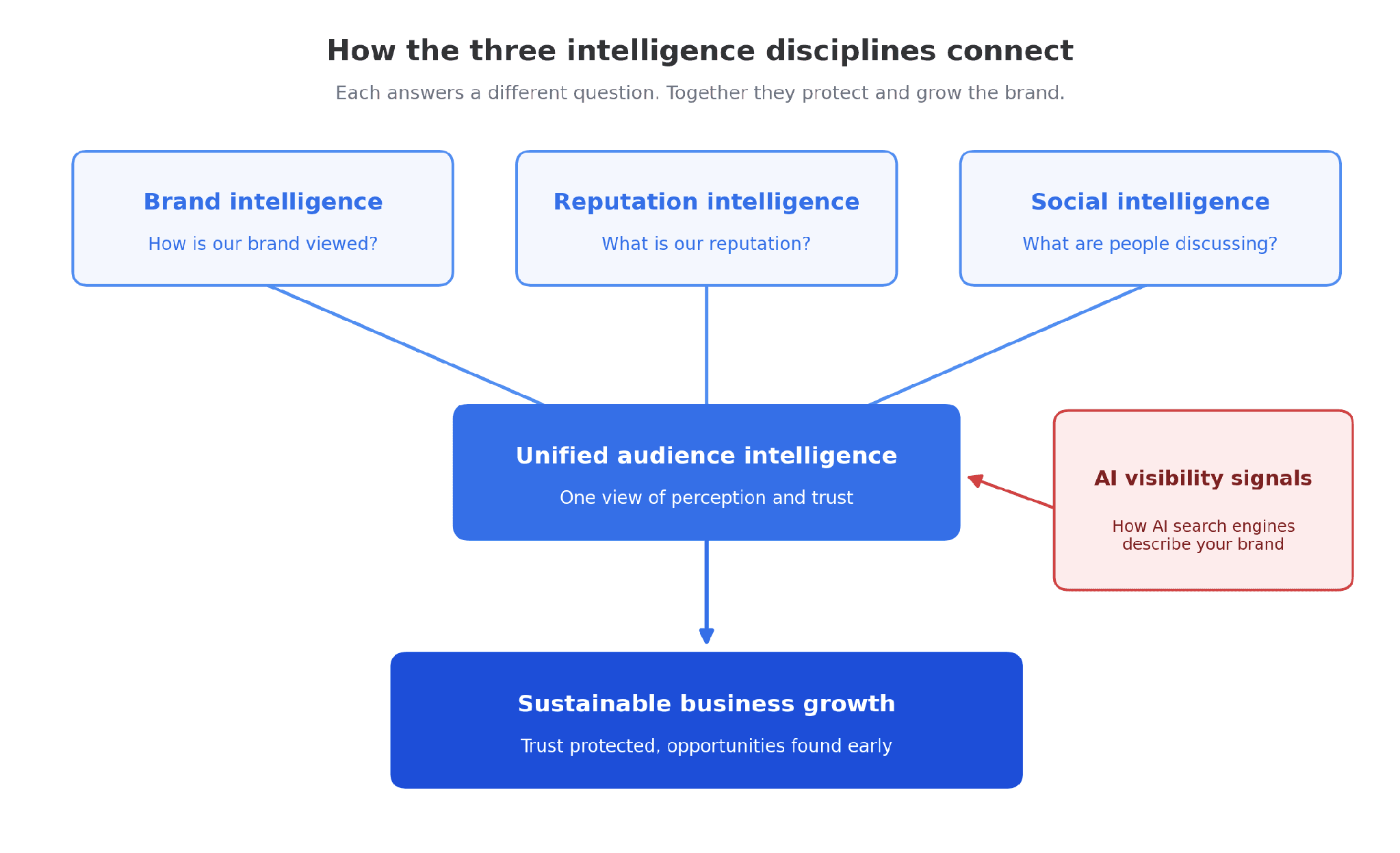
How brand intelligence, reputation intelligence, and social intelligence connect into unified audience intelligence, with AI visibility as an emerging input.
The point of the framework is not three separate listening tools. It is making sure a conversation spotted on social media actually reaches the team that owns positioning and the team that owns trust, before it becomes a headline that either team has to react to.
Real-world applications
Consumer retailers use brand intelligence to understand perception, reputation intelligence to monitor reviews, and social intelligence to catch emerging trends early. SaaS companies track brand positioning alongside customer trust and competitor conversation. Financial institutions lean hardest on reputation intelligence, monitoring trust indicators and responding fast to anything resembling a risk signal. Healthcare organizations track public sentiment and reputation signals that shape patient experience and trust in care.

Executive intelligence dashboard showing brand health, reputation scores, social sentiment, and competitive positioning.
Case study: what it looks like when all three work together
A mid-size consumer electronics brand (a composite example based on patterns common across the industry) had stable brand awareness but a reputation score that had quietly dropped for two straight quarters, and nobody could initially explain why.
Social intelligence surfaced the raw signal first: a spike in TikTok and Reddit posts about a specific product's battery life, starting almost immediately after a software update. Reputation intelligence confirmed the pattern was real, not noise: review sentiment on that specific product had dropped from 4.4 to 3.6 stars in six weeks, concentrated entirely in reviews mentioning battery performance. Brand intelligence showed the damage was still contained; brand-level sentiment had barely moved, meaning the company had a window to fix the specific issue before it became a brand-wide perception problem.
The company rolled back the software update, issued a direct fix within two weeks, and proactively reached out to the reviewers who had posted the original complaints. Two months later, review sentiment on the product recovered to 4.2 stars, the negative social conversation volume dropped by more than 70 percent, and brand-level sentiment, which had never fully cratered, held steady throughout. Catching the issue at the social intelligence stage, rather than waiting for it to become a reputation or brand problem, is very likely what kept it from becoming one.
Common mistakes and how to avoid them
Is anyone treating social listening as a monitoring tool instead of an early warning system? A dashboard that gets checked occasionally catches a crisis after it has already spread; one that triggers an alert on a defined threshold catches it while it is still small.
Are brand, reputation, and social data reviewed by three different teams that never talk to each other? A conversation trend the social team spots often belongs on the brand team's roadmap and the reputation team's radar at the same time, not filed away in three separate reports.
Is reputation only checked after something goes wrong? Reputation intelligence works best as a standing baseline, so a sudden drop is obvious immediately instead of discovered a quarter later during a routine review.
Is anyone tracking sentiment without tracking volume? A sentiment score without conversation volume next to it can hide a real problem; a small, loud, negative conversation and a large, quiet, negative conversation require very different responses.
Does the brand have any idea how AI systems describe it? A company can have an excellent reputation score and still be describing itself very differently than an AI answer engine describes it to a prospective customer, and most reputation programs have no process for catching that gap at all.
Where the field is heading
AI-powered sentiment analysis and reputation forecasting are moving brand and reputation work from reactive monitoring to early prediction, flagging a likely reputation dip before review scores actually move. Automated trend detection is doing the same for social intelligence, surfacing an emerging conversation before it reaches critical mass rather than after.
The bigger shift is toward brand health prediction and competitive intelligence alerts that do not just report a number but flag what is likely to happen to it next, and increasingly, real-time audience insight platforms are adding multi-agent structures: one agent tracking sentiment, one tracking competitor activity, one tracking emerging topics, combined into a single prioritized brief instead of three separate dashboards nobody has time to cross-reference.
A reputation problem caught in the social conversation is a note. The same problem occurs after it hits the review sites is a crisis.
Analytics meets AI search
By now, the throughline should be clear: AI visibility is not a separate discipline from brand, reputation, and social intelligence; it is the same instinct applied to a newer surface. Share of voice in AI-generated answers, consistent brand information across the web, and content clear enough for an AI system to cite accurately all function like the disciplines already covered: measure it, understand why it moved, act on it.
This is precisely the kind of work Subsig focuses on. A brand that has invested heavily in traditional reputation and social monitoring but has never once checked how ChatGPT, Perplexity, or Google's AI Overviews describe it is missing a channel that a growing share of prospective customers now trust more than a search results page.
Your reputation team already knows what customers say about you. Do you know what the AI systems' customers are saying instead?
A few lines worth remembering
A brand is no longer just what a company says about itself. It is what everyone else is saying while nobody from the company is in the room.
A five-star product with a two-star support experience is still a two-star brand to the people living through it.
A reputation problem caught in the social conversation is a note. The same problem occurs after it hits the review sites is a crisis.
Your reputation team already knows what customers say about you. Do you know what the AI systems' customers are saying instead?
Key takeaways
|
Conclusion
A strong product is no longer enough on its own. What people say about a brand, whether they trust it, and what conversations are shaping opinion right now all move the numbers just as much as the product does. Brand intelligence shows perception. Reputation intelligence shows trust. Social intelligence shows that the conversation is driving both. Increasingly, AI visibility adds one more question: when someone asks an AI system about your brand instead of a friend or a search engine, does it get an accurate answer?
The businesses that pull ahead are not the ones with the most listening tools running. They are the ones who connect these signals into one view and act on what that view shows before a competitor does.
Related Articles

AI Visibility

on
AI search in 2026: what's changed, and how businesses can adapt
Buyer research has moved onto AI platforms, and classic search clicks keep falling even as visibility grows. Most B2B brands remain invisible across the platforms their buyers now use. Here is what changed in 2026, and what adapting actually requires.

Brand Mention
on
How to choose the right prompts to track your AI visibility
Choosing the right prompts is the first step to tracking AI visibility effectively. Here are the five categories to cover, examples for each, and what a breakdown of visibility, sentiment, ranking, and sources actually reveals.
AI Visibility
on
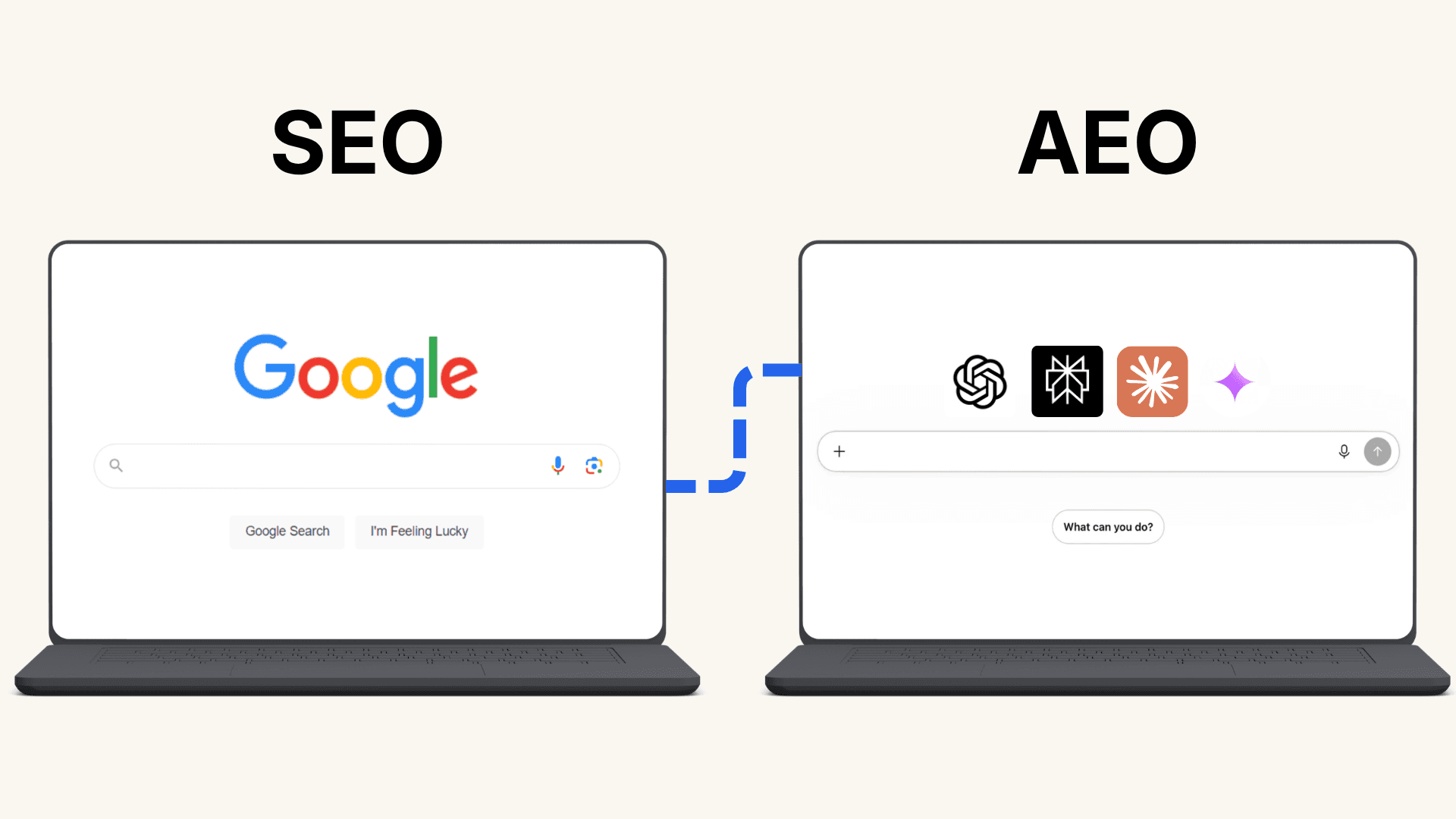
SEO vs AEO: a building block, not a replacement
AEO can feel like a brand-new discipline to learn from scratch, right as clicks from Google search keep dropping. It isn't. AEO is built on the SEO fundamentals already in place, here's how the two actually work together.

AI Visibility
on
How online reviews improve AI visibility: why reviews matter
Online reviews give AI search tools more context about your brand by showing what real customers say about your products or services. Learn how reviews, reputation, and online mentions can support your AI visibility and help AI understand when your brand may be relevant.
AI Visibility
on
AI visibility: AI marketing that reaches decision makers
AI marketing isn't just content and ads anymore, it's how the buying committee actually finds you. Here's who's using ChatGPT, Perplexity, Claude, and Google AI Overview, and why missing even one of them can cost you the sale.

AI Visibility
on
August 2026 ranking dips explained: seasonal trends vs. AI visibility changes
Is your August ranking drop seasonal or AI related? Learn which SEO and AI visibility signals can help you find out.