How to choose the right prompts to track your AI visibility
Choosing the right prompts is the first step to tracking AI visibility effectively. Here are the five categories to cover, examples for each, and what a breakdown of visibility, sentiment, ranking, and sources actually reveals.
By
Subsig Team

AI prompt tracking is the repeated monitoring of a defined set of questions across AI platforms, to measure brand visibility, mentions, competitors, citations, and changes in generated answers over time.
Here are the three most common mistakes.
Guessing. A prompt list generated at random, rather than built from actual search behavior, produces data that does not reflect how buyers ask questions.
Relying on a single category. Tracking only branded terms, or only comparison prompts, produces a prompt list that does not cover the full range of how buyers ask questions, leaving the data incomplete.
Phrasing prompts as keywords rather than questions. A prompt written as a keyword string with a question mark added does not match how a buyer actually asks an AI engine anything, and the tracked result reflects that mismatch, not the brand's actual visibility.
What prompt tracking reveals
Subsig's prompt tracking runs a defined list of prompts and records, for each one, whether a brand is mentioned, its sentiment, its position when ranked against competitors, and the mentions percentage over a set period.
In each prompt, Subsig further breaks down visibility trends over time, brand ranking against named competitors, and the specific domains and URLs being retrieved and cited. Every individual AI response feeding into that prompt is also logged, with the date, the engine, and the sources it pulled from.
This turns a single visibility score into a diagnostic view: which prompts a brand wins, which sources competitors are winning through, and where a brand has zero visibility on a question it should be answering.
How to choose the right prompts
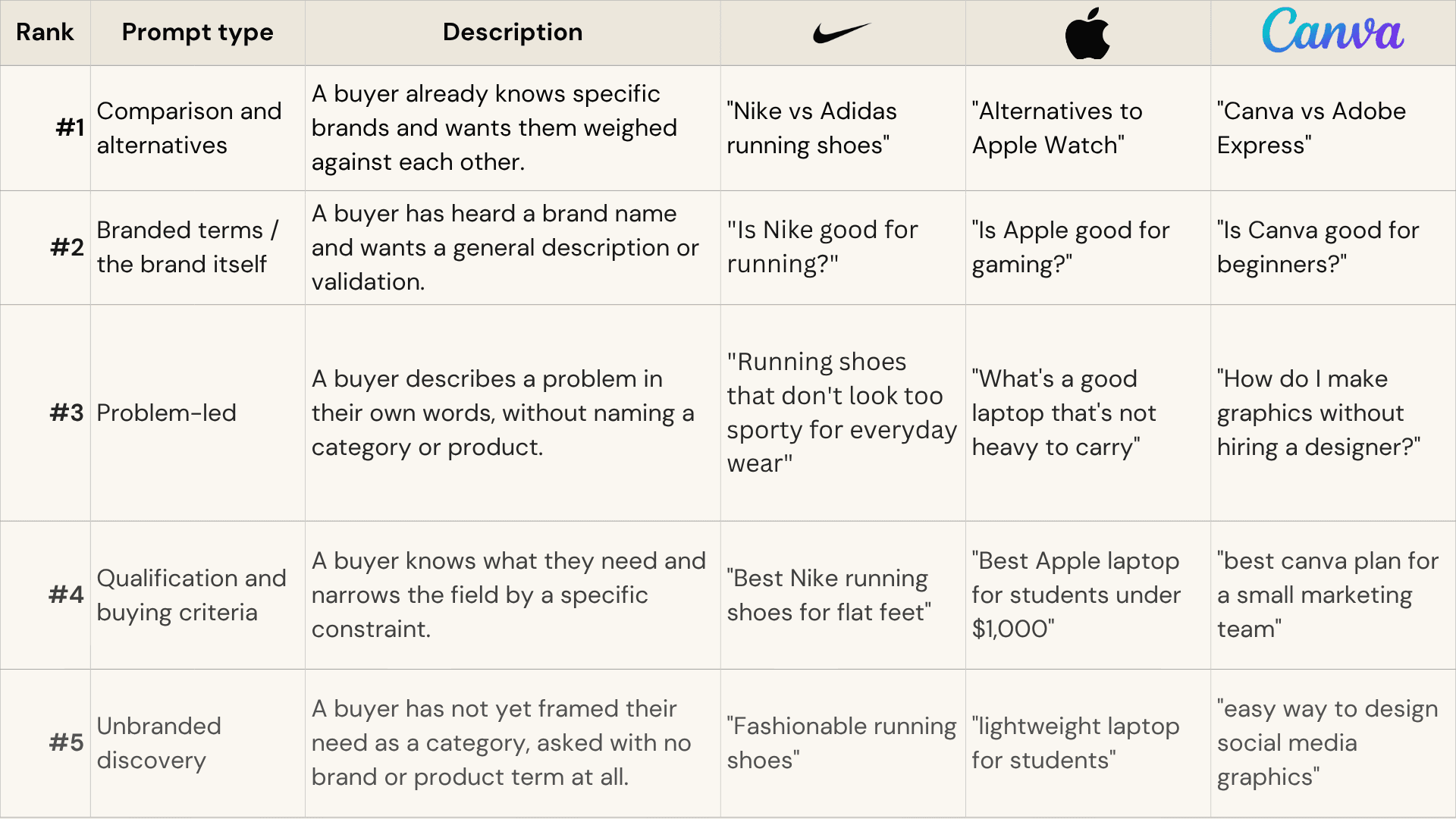
A prompt list built from five categories covers the different ways a buyer asks about a category, rather than testing one type repeatedly.
Comparison and alternatives.
A buyer already aware of specific brands asks an AI engine to weigh them against each other. This tests whether a brand appears in direct comparisons, and whether it is named when a competitor is the anchor point.
Branded terms.
A buyer who has already encountered a brand name asks an engine to describe or validate it. This tests how an engine describes a brand when asked about it directly, including accuracy and tone.
Problem-led.
A buyer who has not yet identified a specific solution describes the underlying issue in their own words. This tests whether a brand's content is structured well enough to show up in response to an unstructured problem statement.
Qualification and buying criteria.
A buyer who knows they need a solution asks an engine to narrow the field by a specific constraint. This tests whether a brand is recommended for the segment it actually serves.
Unbranded discovery.
A buyer has not yet framed their need as a category and asks a general question with no brand or product term. This tests whether a brand's content reaches a buyer at the earliest point in their search.
Choose the right prompts, then see where you stand
Choosing prompts across five categories, and testing them against ChatGPT, Perplexity, Google AI Overview, and Microsoft Copilot, is not something to do once. A prompt list needs revisiting as a brand's category shifts, competitors change, and buyer language evolves.
Running this by hand means testing the same prompts across four engines, on a repeating schedule, and manually logging mentions, sentiment, ranking, and sources for each one. A handful of tools now exist to help with this, Semrush, Profound, and Ahrefs among them, each tracking some version of prompt-level visibility.
Subsig runs this automatically, breaking down every tracked prompt into visibility trends, brand ranking against competitors, and the specific sources being cited, showing where a prompt list is working and where it needs attention.
Ready to track your AI visibility?
Related Articles
Brand Mention

on
How to choose the right prompts to track your AI visibility
Choosing the right prompts is the first step to tracking AI visibility effectively. Here are the five categories to cover, examples for each, and what a breakdown of visibility, sentiment, ranking, and sources actually reveals.
AI Visibility
on
SEO vs AEO: a building block, not a replacement
AEO can feel like a brand-new discipline to learn from scratch, right as clicks from Google search keep dropping. It isn't. AEO is built on the SEO fundamentals already in place, here's how the two actually work together.

AI Visibility
on
How online reviews improve AI visibility: why reviews matter
Online reviews give AI search tools more context about your brand by showing what real customers say about your products or services. Learn how reviews, reputation, and online mentions can support your AI visibility and help AI understand when your brand may be relevant.

AI Visibility
on
AI visibility: AI marketing that reaches decision makers
AI marketing isn't just content and ads anymore, it's how the buying committee actually finds you. Here's who's using ChatGPT, Perplexity, Claude, and Google AI Overview, and why missing even one of them can cost you the sale.

AI Visibility
on
August 2026 ranking dips explained: seasonal trends vs. AI visibility changes
Is your August ranking drop seasonal or AI related? Learn which SEO and AI visibility signals can help you find out.

AI Visibility
on
The AI visibility gap: Why engines recommend different brands
We ran the same prompt across ChatGPT, Claude, Perplexity, and Google AI Overview and got four different answers. Here’s what it means, and why the gap in AI visibility matters more than you'd expect.