How to Track Brand Mentions Across the Web
Tracking brand mentions across the web takes a repeatable process: list name variations, cover every source type, centralize the feed, and review on a cadence.
By
Subsig Team

A brand gets mentioned in more places than most teams realize: a tweet without a tag, a comparison thread on Reddit, a passing reference in an industry newsletter, a Capterra review that never gets a company reply. Finding these requires more than checking the accounts a business already owns.
Tracking brand mentions is a process, not a single tool decision. It means knowing which name variations to search for, setting up coverage across social platforms, news and web content, and communities, and then pulling it all into a feed someone actually checks and acts on.
This article walks through that process step by step: what to set up before starting, how to track mentions across social platforms, news and web content, communities, and review sites specifically, and how to build a workflow that turns tracked mentions into something useful.
What You Need Before You Start Tracking Mentions
Before setting anything up, write down every variation of the brand name worth tracking: the full legal name, common shortenings, frequent misspellings, and product names that might be mentioned without the parent brand attached. Also decide who owns reviewing what gets found and how much time they can commit weekly. Skipping this groundwork is the most common reason mention tracking produces a lot of noise but very little useful signal.
The Practical Process for Tracking Brand Mentions
The process below scales from a single founder checking mentions manually to a team monitoring dozens of sources.

The six-step process: list name variations → track social → track news & web content → track communities & forums → centralize → review & respond on a cadence.
Step 1: List Every Brand Name Variation
Include the full brand name, common abbreviations, frequent misspellings, and product names that might appear without the company name attached. Comprehensive tracking depends on this list being right before anything else gets set up.
Step 2: Set Up Tracking on Social Platforms
Social conversation moves fast and rarely tags a business directly. This step covers native search, saved searches, and any listening tools available on the platforms where the brand's audience is actually active.
Step 3: Set Up Tracking on News and Web Content
This covers news coverage, blog posts, and general web mentions that a dedicated media monitoring setup can catch, beyond what shows up in a manual search.
Step 4: Set Up Tracking on Communities and Forums
Reddit threads, industry forums, and niche community sites often carry candid brand mentions that never surface through social or news tracking, but they require a different search approach since most don't support native alerts.
Step 5: Centralize Everything Into One Feed
Once tracking is running across several source types, checking each one separately becomes the bottleneck. Centralizing into a single feed, whether through a dedicated tool or a shared inbox pulling in alerts from each source, is what keeps the process usable.
Step 6: Review and Respond on a Regular Cadence
Beyond reacting to individual mentions, set a recurring time to look at volume trends, sentiment shifts, and where the brand is being discussed most. This is where tracking turns into insight instead of just a stream of alerts
See here: Using Google Alerts for Reputation Management | Brand Name Monitoring
How to Track Mentions on Specific Source Types
The general process above applies everywhere, but the setup looks different depending on the type of source.
Social Platforms
On X, use the native search bar with the brand name in quotes, and save the search for repeated checking. LinkedIn mentions are harder to search natively, so periodic manual checks or a listening tool are usually necessary. Both platforms surface far more untagged conversation than a business's own notifications will ever show.
News and Web Content
Set up a free alert through Google Alerts for each brand name variation, and check Google News periodically for coverage that alerts might miss. This catches a meaningful share of press and blog mentions, though it isn't exhaustive and can lag real-time by a day or more.
Communities and Forums
On Reddit, use its native search for the brand name across relevant subreddits, since Reddit content is often not fully indexed by Google Alerts. Hacker News and niche industry forums typically require a manual periodic search, as most don't offer any notification system at all.
Review Sites
Reviews on platforms like Google, Trustpilot, and G2 are technically a structured form of brand mention, and tracking them typically falls under a dedicated review monitoring setup rather than general web mention tracking, since each platform has its own business dashboard and notification system.
Common Mistakes to Avoid When Tracking Brand Mentions
Only searching the exact brand name. Misspellings, abbreviations, and product names often carry a meaningful share of total mention volume.
Relying on Google Alerts alone. It's a useful free layer but misses most real-time social conversation and much of what's discussed in forums and communities.
Not filtering out irrelevant results. Brands with common names need extra filtering to separate relevant mentions from unrelated noise.
Tracking mentions with no plan to act on them. Without a clear owner and response process, tracking just produces a growing list of unread alerts.
Checking only when something feels urgent. Mentions tracked only reactively miss the slow-building patterns that matter most, like a recurring complaint gaining traction.
How to Measure Whether Your Mention Tracking Process Is Working
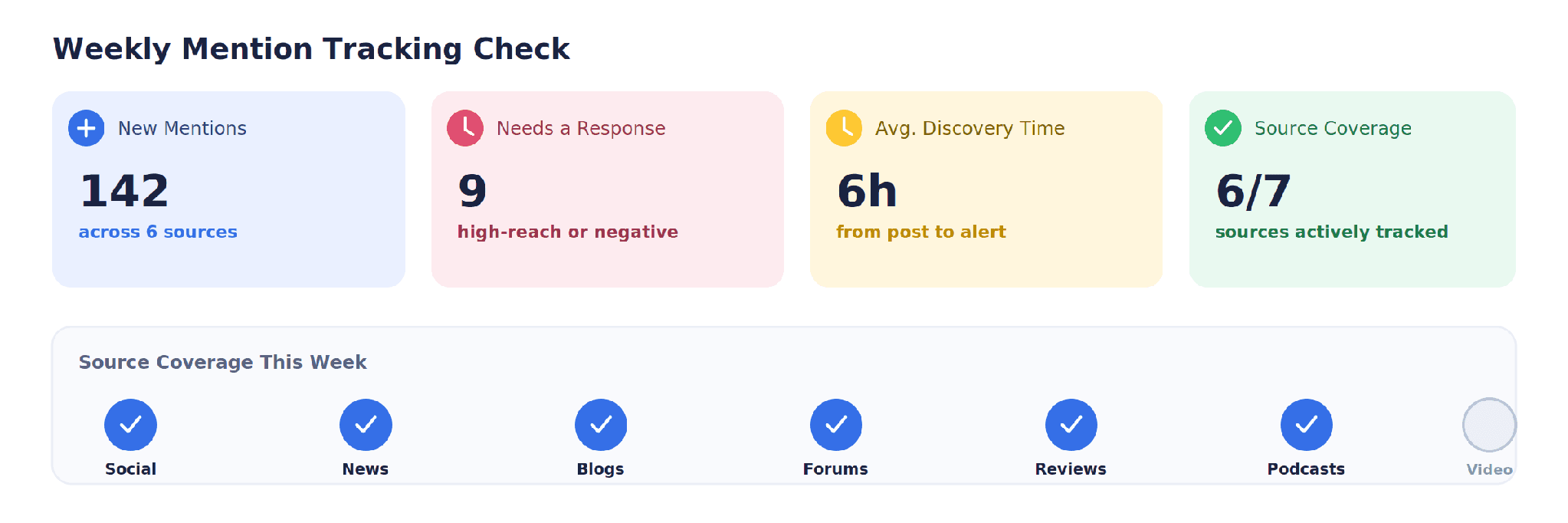
A simple weekly health check: new mentions, mentions needing a response, average discovery time, and source coverage.
A working process should be checkable at a glance weekly, using a small set of numbers:
New mentions — how many came in since the last check, and across which source types.
Mentions needing a response — how many carry enough reach or negative sentiment to warrant action, rather than simple awareness.
Average discovery time — how long it takes from when a mention is posted to when it's actually seen, which matters most for anything time-sensitive.
Source coverage — whether every priority source type is actually being tracked, since gaps tend to appear quietly in the hardest-to-monitor places first, like niche forums.
If discovery time is consistently slow or a specific source type keeps producing zero results, that's usually a sign the tracking setup for that source needs a second look, not that mentions simply aren't happening there.
See here: How to Monitor Brand Mentions for SEO (4 Proven Methods)
This process covers finding mentions. Reviews specifically are usually handled through a dedicated review management setup, and the patterns across both feed into broader reputation monitoring. Mention data also increasingly shapes AI visibility monitoring, since AI-generated answers draw on much of the same public conversation this process is built to surface.
Final Thoughts
Tracking brand mentions doesn't require monitoring every corner of the internet at once. It requires a clear list of name variations, coverage across the source types that actually matter for the brand, a way to centralize what's found, and someone responsible for reviewing it regularly.
The practical next step is to run through the six-step process manually for one week, using free tools where possible, before deciding whether a dedicated tracking tool is worth the investment. That first week usually makes clear which source types are producing the most valuable mentions and where manual tracking is most likely to fall short.
Let Subsig Track Every Mention in One Place
Subsig centralizes brand mention tracking across social, news, communities, and review platforms into a single feed, with alerts and sentiment built in. If the process above feels manageable for one or two source types but overwhelming across all of them, that's usually the point where centralizing pays off.
Related Articles

AI Visibility

on
AI search in 2026: what's changed, and how businesses can adapt
Buyer research has moved onto AI platforms, and classic search clicks keep falling even as visibility grows. Most B2B brands remain invisible across the platforms their buyers now use. Here is what changed in 2026, and what adapting actually requires.

Brand Mention
on
How to choose the right prompts to track your AI visibility
Choosing the right prompts is the first step to tracking AI visibility effectively. Here are the five categories to cover, examples for each, and what a breakdown of visibility, sentiment, ranking, and sources actually reveals.
AI Visibility
on
SEO vs AEO: a building block, not a replacement
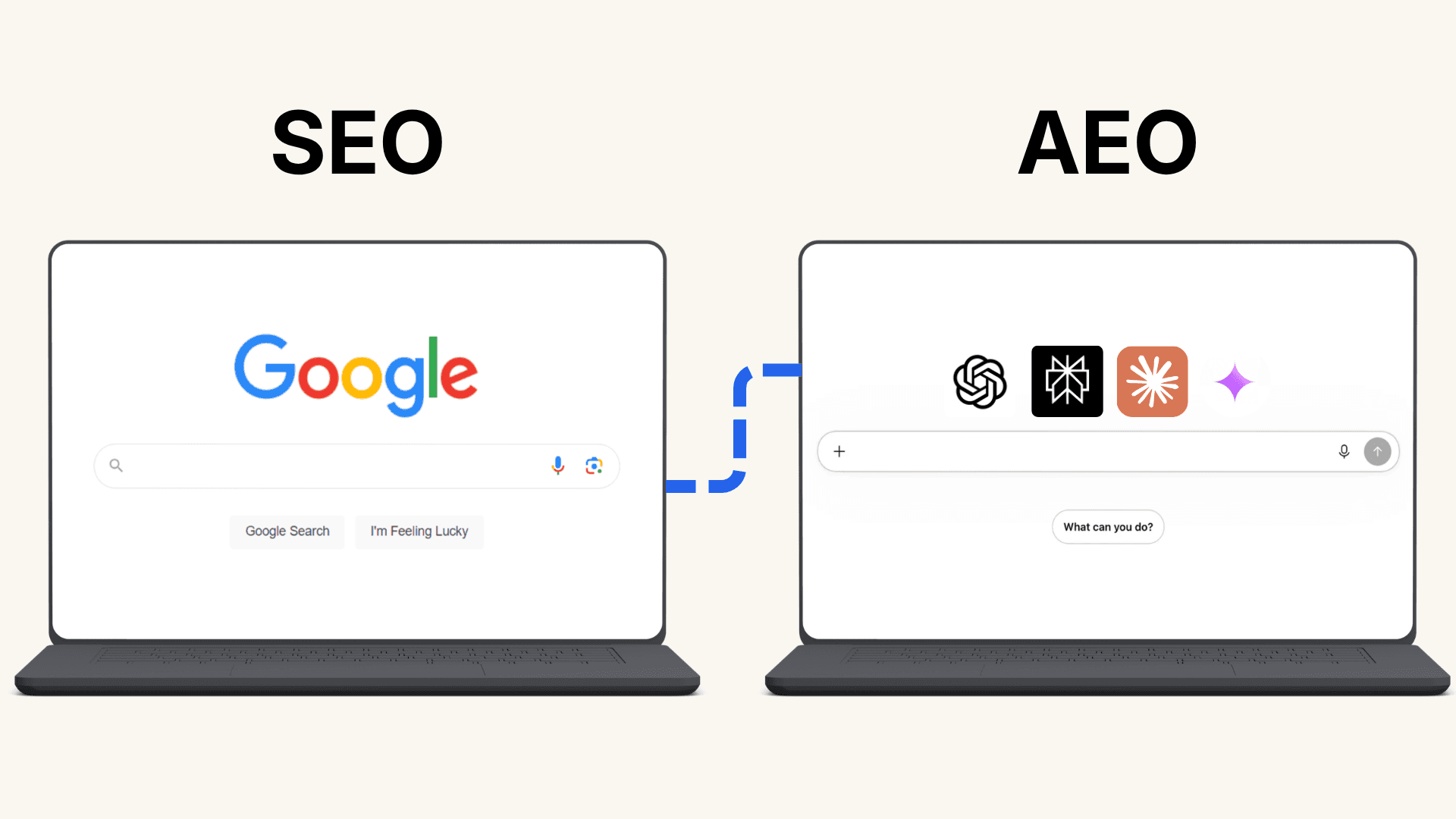
AEO can feel like a brand-new discipline to learn from scratch, right as clicks from Google search keep dropping. It isn't. AEO is built on the SEO fundamentals already in place, here's how the two actually work together.

AI Visibility
on
How online reviews improve AI visibility: why reviews matter
Online reviews give AI search tools more context about your brand by showing what real customers say about your products or services. Learn how reviews, reputation, and online mentions can support your AI visibility and help AI understand when your brand may be relevant.
AI Visibility
on
AI visibility: AI marketing that reaches decision makers
AI marketing isn't just content and ads anymore, it's how the buying committee actually finds you. Here's who's using ChatGPT, Perplexity, Claude, and Google AI Overview, and why missing even one of them can cost you the sale.

AI Visibility
on
August 2026 ranking dips explained: seasonal trends vs. AI visibility changes
Is your August ranking drop seasonal or AI related? Learn which SEO and AI visibility signals can help you find out.