The AI visibility gap: Why engines recommend different brands
We ran the same prompt across ChatGPT, Claude, Perplexity, and Google AI Overview and got four different answers. Here’s what it means, and why the gap in AI visibility matters more than you'd expect.
By
Subsig Team

Asking four different people the same question and you’ll get four different answers. All of them are shaped by what each of them knows, and where they think to look. Same goes with AI engines.
The same prompt, run through ChatGPT, Claude, Perplexity, and Google AI Overview, can come back with different answers, different brand recommendations, from different sources, and sometimes no clear answer at all.
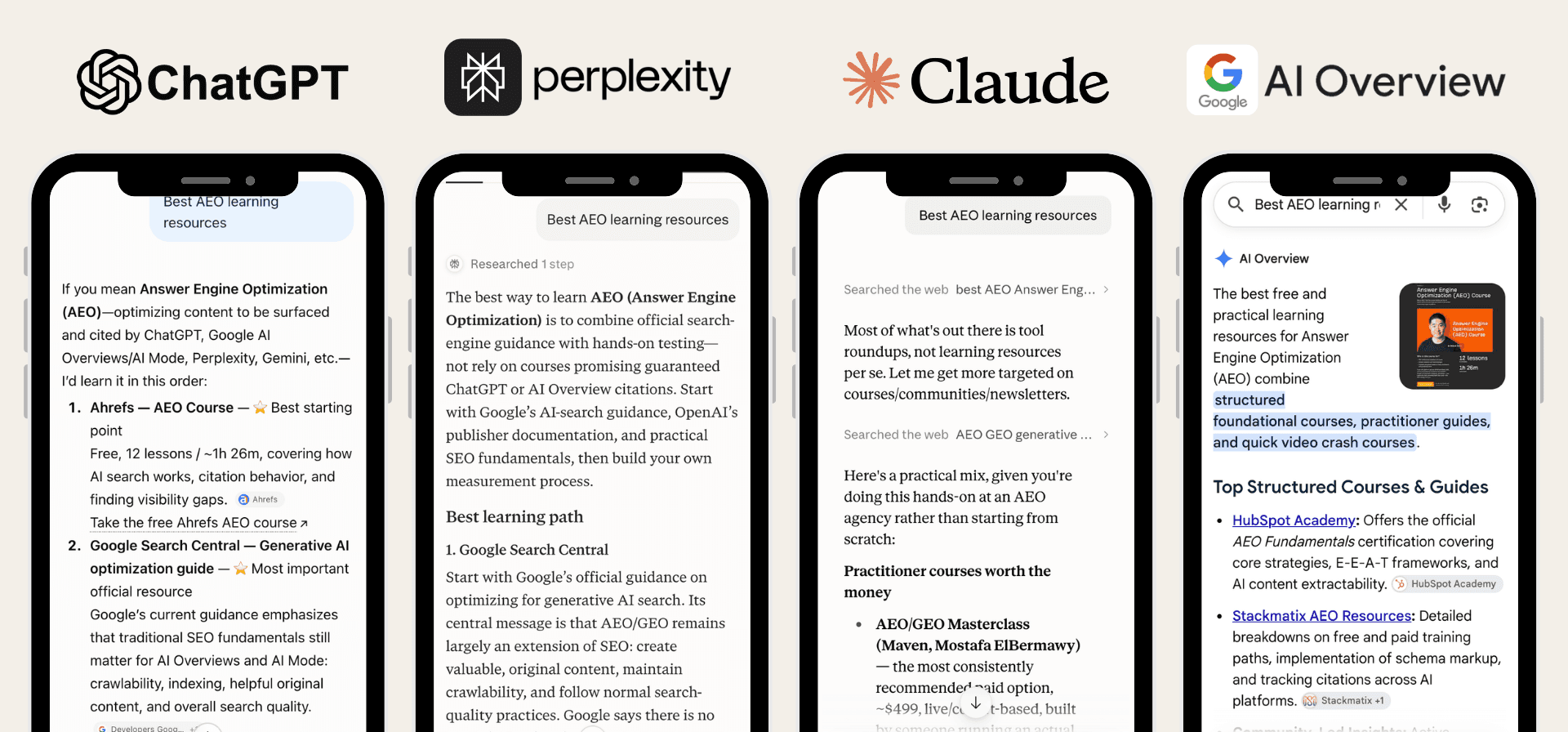
We ran ‘Best AEO learning resources’ on ChatGPT, Perplexity, Claude and Google AI Overview, and here’s what we got:
AI visibility isn't one size fits all
ChatGPT may recommend you. Perplexity may stay silent on the same question. Claude might cite a competitor instead. Google AI Overview might leave you out of the answer even if you rank first.
According to Forrester's survey, 94% of B2B buyers now use AI during their most recent purchase process, comparing providers and researching products. And for B2B SaaS specifically, that research doesn't happen evenly across engines.
Here’s where the decision makers are:
Who | Where | Key Stats |
|---|---|---|
Google users | Google AI Overview | B2B Tech queries now trigger an AI Overview 82% of the time, from 36% |
Early-stage researchers | ChatGPT | 42% of B2B buyers use ChatGPT during research, more than any single alternative platform |
Economic buyer / decision-makers | Perplexity | Despite smaller user base, Perplexity holds 24% share of purchase-intent queries |
Techincal evaluator / developer | Claude | Claude leads the enterprise LLM market with 32% share by usage, ahead of OpenAI's 25% |
Procurement / final approver | Perplexity / Claude | 71% of procurement professionals trust AI-generated shortlists more than a traditional consultant |
In tackling AEO, it is important that you understand how AI answer engines work, how they think, and where they search.
In achieving AI visibility, the next question is how your brand actually performs inside that system, where the gap is, and where to take action.
Here’s what we know
Each engine runs on different logic entirely, some check their own memory first, some search every time, and none of them look in the same place. That's the real reason the same question comes back with four different answers.
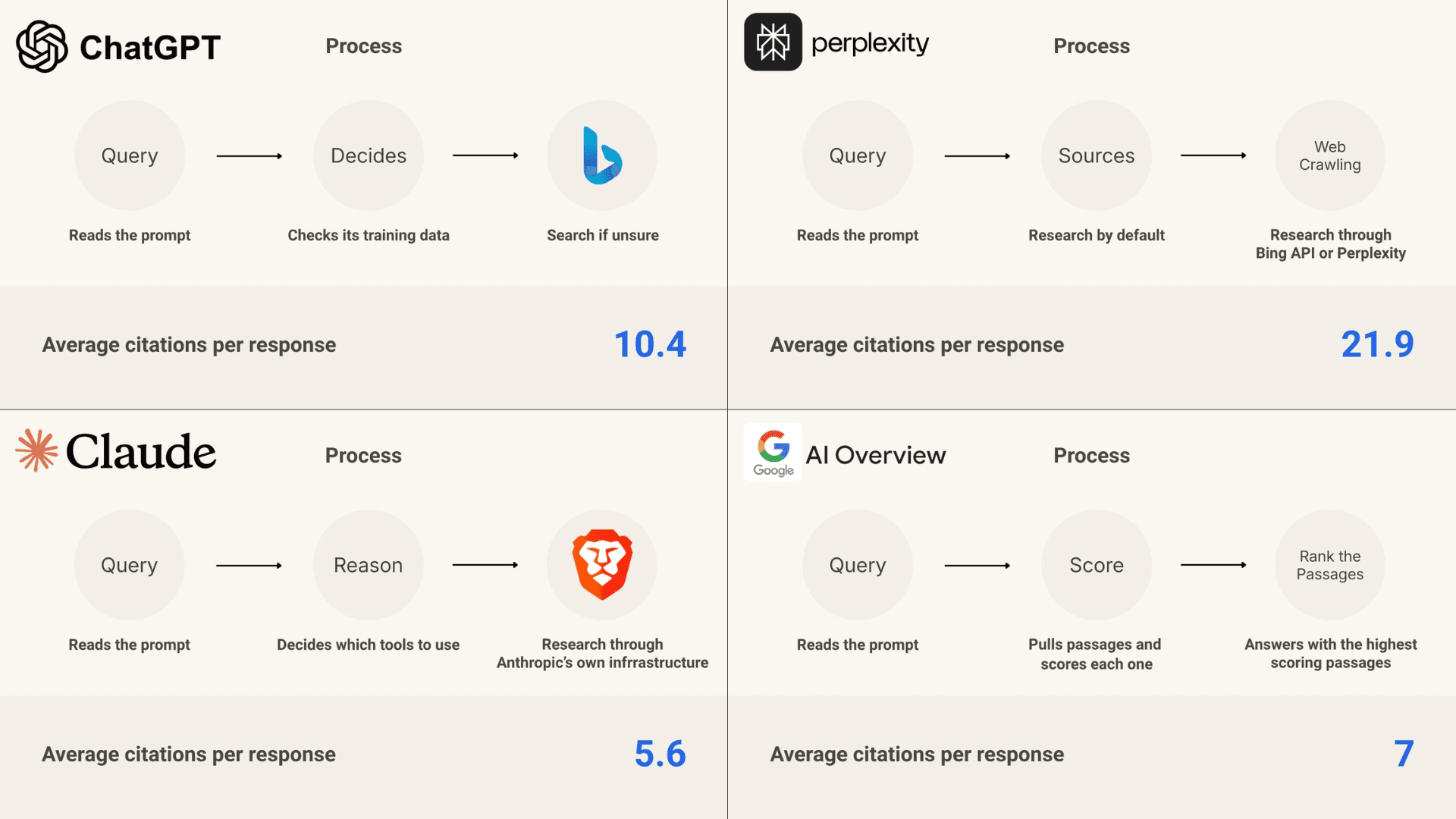
Sources: LawrenceHitches, Storyzee, Singularity Digital, Discovered Labs
Know your numbers
Understanding how your brand performs across AI search engines comes down to knowing where you stand, where you are still invisible to AI, and what more you need to do.
That means you need to track how often your brand comes up in AI answers, where you rank against your competitors, where AI gets the citations from, how frequently your own domain gets cited, and what the answers are actually saying about you.
Tracking this by hand means running the same prompts across different engines, every week, because the numbers keep changing.
Track it automatically
Running these checks by hand, every week, across four engines, isn't something most teams have the capacity for.
There are different automated tools available at different prices, covering different ranges, such as Otterly AI, Profound, Peec AI, Rankscale, and others.
In a single dashboard, Subsig tracks how often your brand comes up across ChatGPT, Claude, Perplexity, and Google AI Overviews, and all the numbers mentioned above, starting at $0/month. Equipped with an AI agent that turns those numbers into actionable steps and roadmap to help you improve your AI visibility.
Want to see where your brand actually stands? Start here.
Ready to have professionals take care of it for you and get your brand to become the brand AI recommends? Book a call here.
Related Articles

AI Visibility

on
AI search in 2026: what's changed, and how businesses can adapt
Buyer research has moved onto AI platforms, and classic search clicks keep falling even as visibility grows. Most B2B brands remain invisible across the platforms their buyers now use. Here is what changed in 2026, and what adapting actually requires.

Brand Mention
on
How to choose the right prompts to track your AI visibility
Choosing the right prompts is the first step to tracking AI visibility effectively. Here are the five categories to cover, examples for each, and what a breakdown of visibility, sentiment, ranking, and sources actually reveals.
AI Visibility
on
SEO vs AEO: a building block, not a replacement
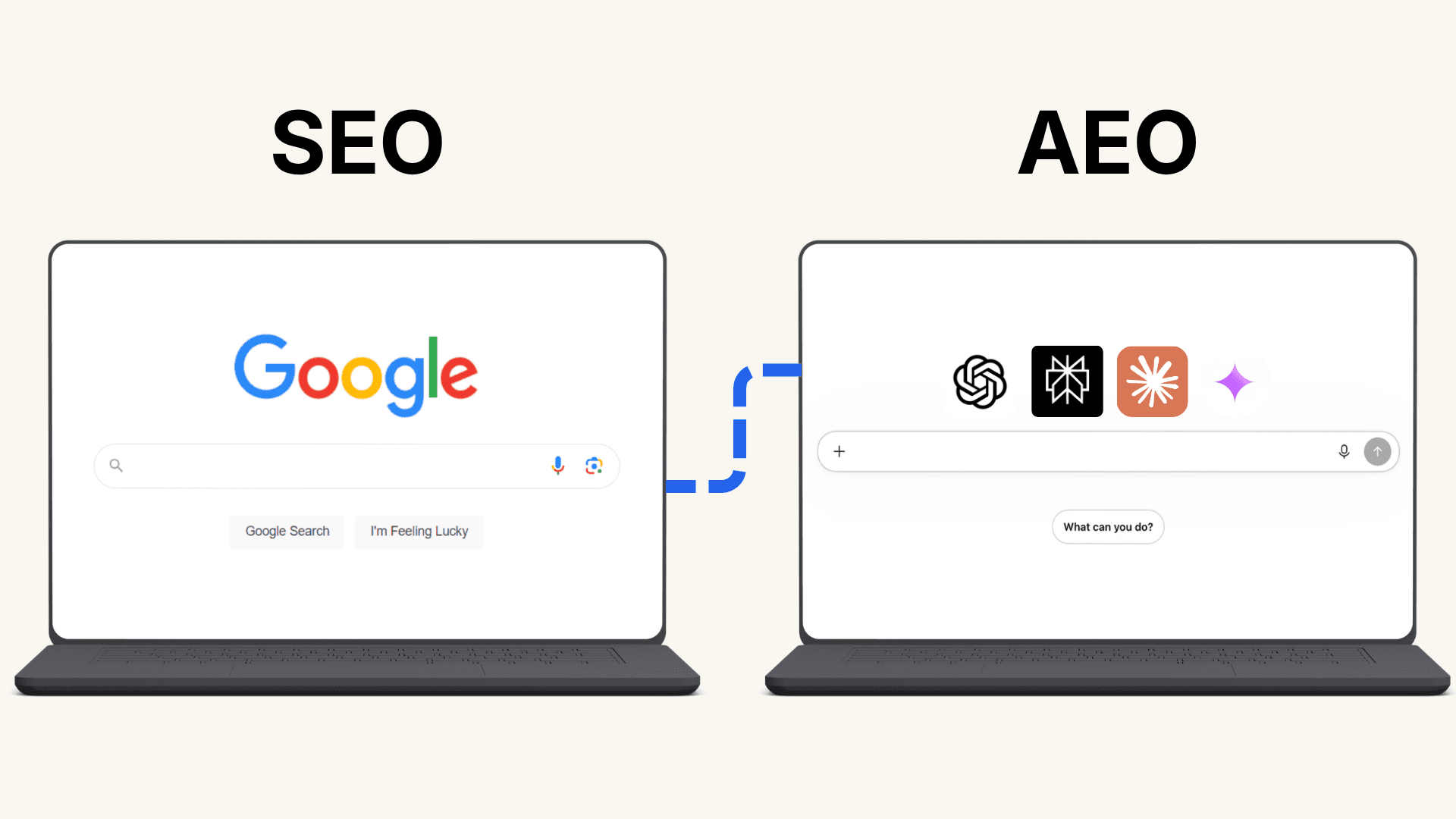
AEO can feel like a brand-new discipline to learn from scratch, right as clicks from Google search keep dropping. It isn't. AEO is built on the SEO fundamentals already in place, here's how the two actually work together.

AI Visibility
on
How online reviews improve AI visibility: why reviews matter
Online reviews give AI search tools more context about your brand by showing what real customers say about your products or services. Learn how reviews, reputation, and online mentions can support your AI visibility and help AI understand when your brand may be relevant.
AI Visibility
on
AI visibility: AI marketing that reaches decision makers
AI marketing isn't just content and ads anymore, it's how the buying committee actually finds you. Here's who's using ChatGPT, Perplexity, Claude, and Google AI Overview, and why missing even one of them can cost you the sale.

AI Visibility
on
August 2026 ranking dips explained: seasonal trends vs. AI visibility changes
Is your August ranking drop seasonal or AI related? Learn which SEO and AI visibility signals can help you find out.