5 Best Trustpilot Alternatives for Business Reviews (2026)
Is it time to find a more software-focused alternative to Trustpilot Business?
Trustpilot’s generic consumer focus often allows for low-quality or irrelevant feedback that doesn't help B2B buyers understand the technical value of your specific platform.
That’s why marketing heads are utilizing Subsig to discover authentic user testimonials in organic conversations that carry more weight than a star rating.
This guide compares top Trustpilot alternatives, why the platform struggles with verified software feedback, and how Subsig uncovers the social proof that truly moves the needle.
Start for free. Control the signals buyers and AI trust.
Compare Trustpilot Alternatives




Main Use
Public reviews
SaaS marketplace
Verified reviews
eCommerce UGC
Review widgets
B2B monitoring
Pricing
$250+/mo
$299+/mo
£149+/mo
$199+/mo
$15–$99/mo
$39–$99/mo
Alert Speed
Near real-time
Near real-time
Real-time
Real-time
Daily
Founders & SaaS users
Coverage
Web-wide
B2B software
Transactional
eCommerce
Multi-source
B2B platforms
Best For
Consumer brands
Software vendors
Retailers
Shopify brands
SMB marketers
SaaS teams
API Access
Enterprise only
Yes
Yes
Yes
Limited
Yes
Ease of Use
Medium
Medium
Medium
Medium
Very easy
Easy
Subsig (Best for B2B SaaS Teams)
Plans from $39–$99/month
Subsig s a reputation and AI visibility platform that pulls your brand’s reviews and social mentions into one place to turn human signals into actionable insights. It automatically finds everywhere your product is being discussed and benchmarks you against the competitors you actually get mentioned alongside.
Unlike Brand24, which casts a wide net across consumer platforms, Subsig.com focuses on where real B2B conversations happen:
X (Twitter), LinkedIn, Reddit, GitHub, Hacker News, Stack Overflow, YouTube, newsletters, podcasts, and news.
Instead of flooding your inbox with irrelevant mentions, Subsig.com uses AI relevance scoring to filter out 80–90% of noise so your team only sees mentions that actually matter.
Why SaaS Teams Choose Subsig.com Over Brand24
Real-time alerts instead of daily digests
Full data access on every plan (API, webhooks, exports included)
Native coverage of technical platforms Brand24 doesn’t support
AI filtering that removes spam, false positives, and low-intent mentions
No enterprise lock-in just to build workflows
Key Features
B2B-First Platform Coverage
Monitor conversations across X, LinkedIn, Reddit, GitHub, Hacker News, Stack Overflow, YouTube, DEV, newsletters, podcasts, and news.
AI Relevance Scoring
Automatically surfaces high-intent mentions like buying signals, product comparisons, and technical discussions—while hiding noise.
Build Custom Workflows
Use APIs, webhooks, MCP servers, Slack alerts, and exports on all plans—no enterprise upgrade required.
Real-Time Alerts
Get notified within minutes via Slack, email, or webhooks when something important happens.
Review Platforms Support














Social Platforms Support



Pros
Built specifically for B2B SaaS teams, not consumer brands
Real-time alerts instead of delayed daily digests
AI relevance scoring filters out 80–90% of noise automatically
Full data access on all plans (API, webhooks, exports included)
Native coverage of technical platforms like GitHub, Hacker News, and Stack Overflow
Cons
Less emphasis on long-term trend and historical reporting
Newer platform with lower brand recognition than legacy tools
No Instagram or Facebook monitoring
Smaller ecosystem of third-party integrations compared to enterprise tools
Not designed for consumer or influencer-focused use cases
Trustpilot (Best for Consumer Brand Credibility)
Pricing: Free to $250+/month (Standard)
Trustpilot is a leading open-review platform that hosts millions of public business profiles, allowing anyone to share their customer experience. It provides businesses with a recognizable "TrustScore" and a suite of tools to invite customers, manage replies, and display reviews on their own websites.
When Trustpilot Makes Sense
Trustpilot makes sense for consumer-facing (B2C) brands that need a highly recognizable "seal of approval" to build instant trust with new shoppers. It is ideal for companies with high transaction volumes that want a public-facing profile to influence search engine results and social proof.
Best For
High-volume B2C and retail brands
Brands needing a public "TrustScore"
Companies focusing on SEO star ratings
Businesses with global consumer audiences
Teams wanting automated email review invitations
Key Features
TrustScore: A highly recognized 5-star rating system
Automated invitations: Sends review requests after a purchase
Fraud detection: AI-driven tools to identify fake reviews
Review widgets: Embeds public feedback on your website
Social sharing: Easy tools to share reviews on social
Pros
Massive global brand recognition
Improves organic search engine visibility
Large existing base of active reviewers
Easy integration with major eCommerce tools
Strong automated invitation system
Cons
Vulnerable to "review bombing" attacks
High cost for standard business features
"Open" platform means anyone can post
Widgets offer limited customization
Customer support is often slow
G2 (Best for B2B Software Marketplace Presence)
Pricing: $299+/month (Free basic profiles)
G2 is the world’s largest software marketplace, focusing specifically on B2B software and services through verified peer reviews. It provides vendors with "Grid Reports" and buyer intent data, helping them understand who is researching their product and how they compare to competitors.
When G2 Makes Sense
G2 makes sense for software companies (SaaS) that need to be discovered by professional buyers during the evaluation phase of the sales cycle. It is for vendors who want to leverage their user base to win "Category Leader" badges and drive high-quality leads.
Best For
SaaS and B2B software vendors
Marketing teams needing buyer intent data
Companies wanting category-leading award badges
Vendors managing complex multi-product portfolios
Sales teams tracking competitor research trends
Key Features
Buyer intent data: Identifies companies researching your software
Video reviews: Collects and hosts video-based user testimonials
Content syndication: Pushes reviews to LinkedIn and other platforms
Custom CTAs: Places "Request Demo" buttons on your profile
G2 Grid Reports: Quarterly rankings of category performance
Pros
The gold standard for software reviews
Valuable intent data for sales teams
High-quality, verified professional reviewers
Strong SEO for "Alternative" search queries
Excellent badge assets for marketing
Cons
Very expensive for premium tiers
High effort to maintain Grid rankings
Intent data requires expensive integration
Review forms are long and complex
Niche focus on software and services
Feefo (Best for Verified Transactional Reviews)
Pricing start at ~£149/month ($190+)
Feefo is a "closed" review platform that only allows verified customers who have made a purchase to leave feedback. This ensures that every review is authentic and prevents the fake or malicious feedback often found on open platforms like Trustpilot.
When Feefo Makes Sense
Feefo makes sense for retailers and service providers who want 100% certainty in the authenticity of their feedback. It is for brands that prioritize data integrity and want to use "Verified" status to reassure customers throughout the checkout process.
Best For
Ethical retailers and service providers
Brands wanting 100% verified feedback
Companies in regulated industries
Teams needing advanced sentiment analysis
Businesses focusing on high-integrity social proof
Key Features
Advanced AI insights: Maps sentiment to specific product traits
Closed-loop feedback: Only customers can leave reviews
Sustainability "Treefo": Plants trees for every review collected
Global support: Multi-language collection in 25+ languages
Photo and video reviews: Encourages UGC directly in the review
Pros
Zero risk of fake or malicious reviews
High trust due to "Verified" status
Unique sustainability-linked review campaigns
Very clean and professional website widgets
Strong integration with Google Shopping
Cons
No "open" public profile discovery
Lower review volume than open platforms
Higher starting price than entry-level tools
Dashboard can feel technical for beginners
Limited free tier options
Yotpo (Best for eCommerce Growth & UGC)
Pricing starts at $19-199+/month (Bundle options available)
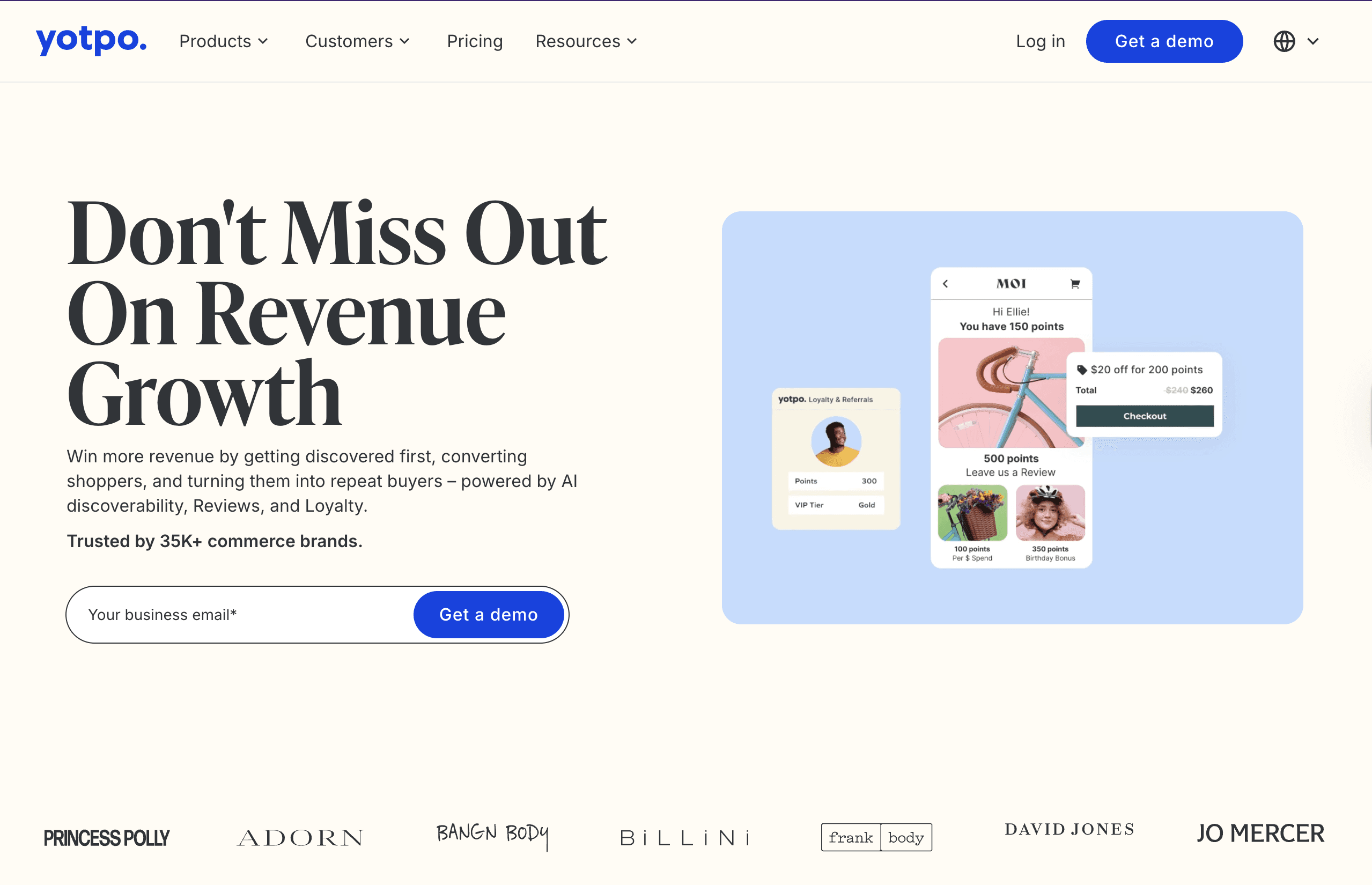
Yotpo is a comprehensive eCommerce marketing platform that integrates reviews, visual UGC, loyalty programs, and SMS marketing. It focuses on turning reviews into a full-funnel growth engine by connecting customer feedback directly to rewards and repeat purchases.
When Yotpo Makes Sense
Yotpo makes sense for direct-to-consumer (D2C) brands on platforms like Shopify that want an all-in-one growth suite. It is ideal for retailers who want to display customer photos alongside reviews to increase conversion rates on product pages.
Best For
Shopify and D2C eCommerce brands
Brands wanting integrated loyalty and reviews
Companies prioritizing visual UGC and photos
Marketing teams using SMS and email
High-growth retailers scaling their social proof
Key Features
Visual reviews: Shoppers can upload photos and videos
Integrated loyalty: Reward points for leaving a review
Smart filters: Lets shoppers search reviews by specific topics
Syndication: Pushes reviews to Facebook and Instagram shops
CommerceGPT: AI that summarizes reviews for fast reading
Pros
Best-in-class Shopify and eCommerce integration
Connects reviews directly to repeat sales
High engagement with visual UGC tools
Extensive suite of "bundle" marketing tools
Very modern and high-converting widgets
Cons
Can become very expensive as you scale
Many best features require high-tier plans
Support can be inconsistent for small users
Overwhelming feature set for simple needs
Limited focus on B2B or service industries
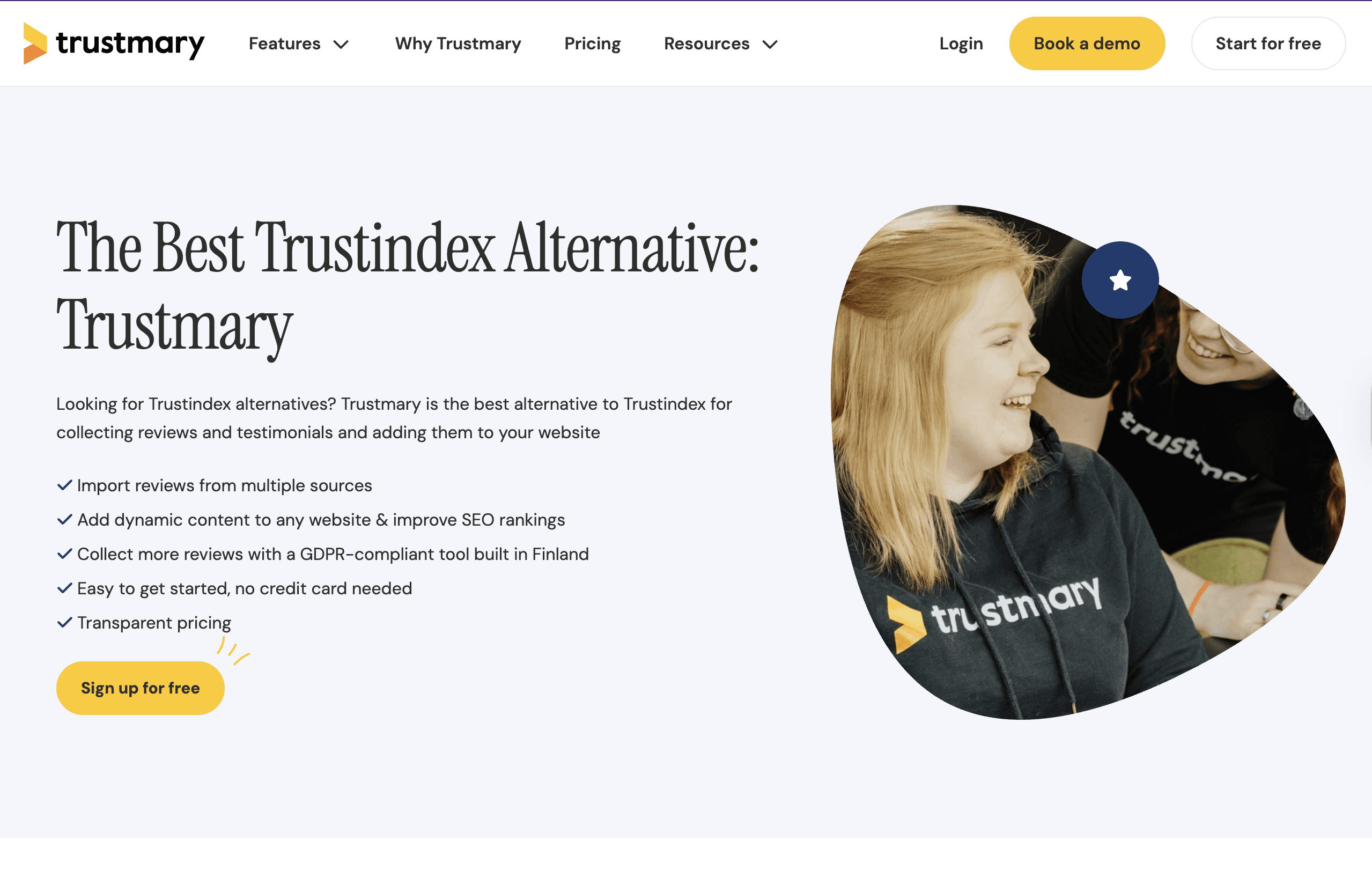
Trustmary (Best for SMB Website Conversions)
Pricing starts at $15–$99/month
Trustmary is a review management tool specifically designed to help small businesses import reviews from multiple sources and turn them into high-converting website widgets. It focuses on the "display" side of reputation, making it easy to show off existing social proof from Google, Facebook, and Trustpilot in one place.
When Trustmary Makes Sense
Trustmary makes sense for small business owners and marketing teams who already have reviews scattered across the web and want to unify them on their site. It is the best choice for those who prioritize lead generation and website conversion over complex data analysis.
Best For
Small business owners and solo pros
Teams needing simple, beautiful website widgets
Brands importing reviews from multiple sources
Marketers focused on website lead conversion
Users wanting "no-code" social proof solutions
Key Features
Multi-source import: Pulls reviews from Google, Yelp, and more
Smart popups: Displays reviews to visitors at peak times
Video testimonials: Built-in tool to collect video feedback
A/B testing: Tests which review widgets convert better
Review generator: Simple campaigns to collect new feedback
Pros
Very affordable for small teams
Fastest way to display unified reviews
High-quality, modern widget designs
Easy "no-code" setup for any CMS
No-risk free trial and monthly billing
Cons
Limited depth in enterprise sentiment data
Not a public "marketplace" for discovery
Fewer advanced API integrations
Limited reporting compared to G2/Yotpo
No built-in loyalty or SMS tools