Review Monitoring: What It Is and Why It Matters
Review monitoring is the practice of tracking customer reviews across every platform where they appear, so businesses can act on feedback before it affects their reputation.
By
Subsig Team

What Is Review Monitoring?
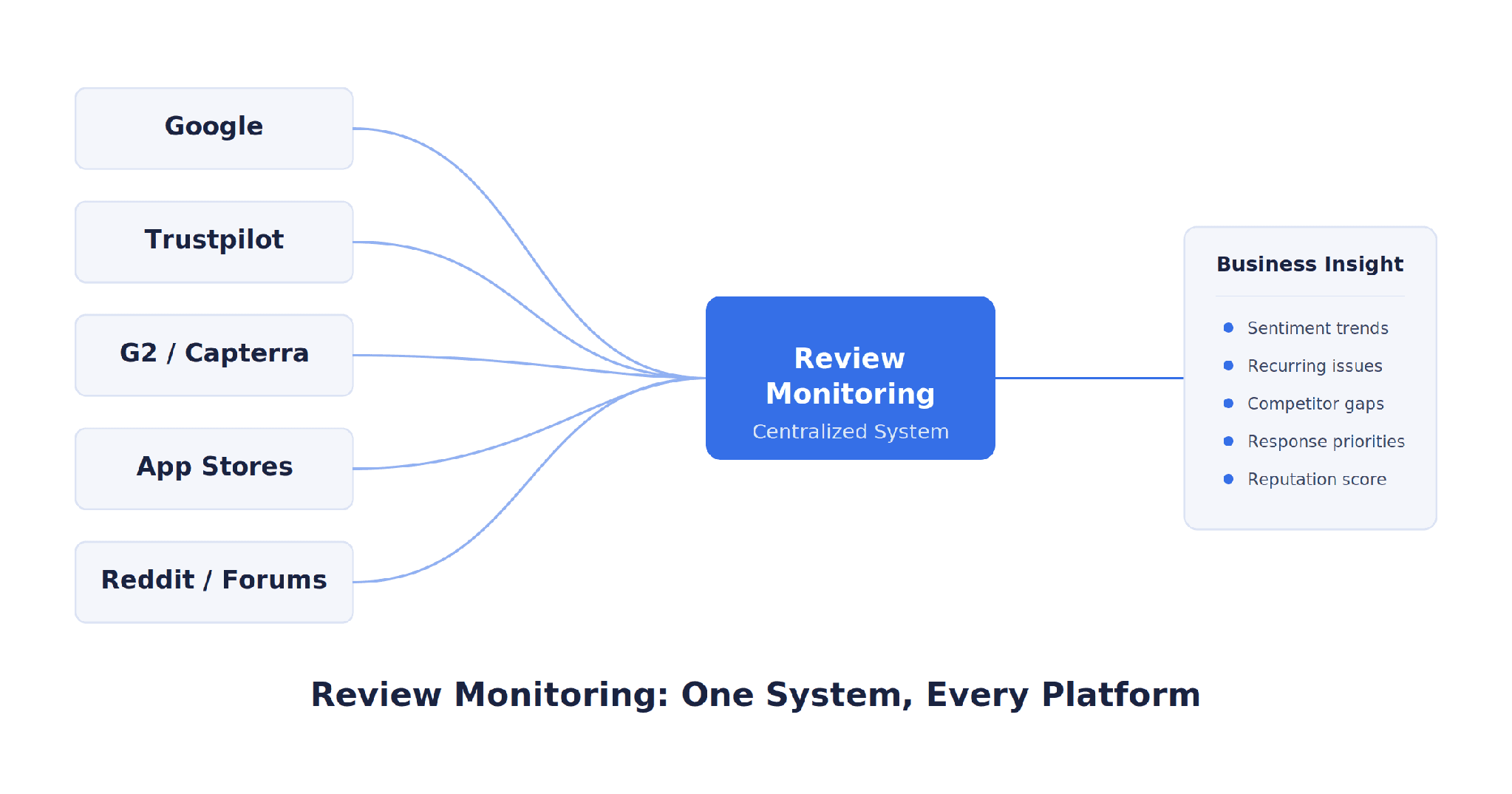
Review monitoring pulls feedback from every platform into one centralized system.
Most businesses find out about a bad review the same way their customers do: by stumbling across it. A frustrated comment on Google goes unanswered for two weeks. A pattern of complaints builds up on Trustpilot without anyone connecting the dots. A one-star app store review sits at the top of the listing while the team is busy elsewhere.
Review monitoring exists to close that gap. It is the ongoing process of tracking, collecting, and analyzing customer reviews across the platforms where a business is discussed, so that feedback gets seen and acted on instead of piling up unnoticed.
This matters because customer opinions no longer live in one place. A single customer's experience with a product can generate a review on Google, a comment on Reddit, a rating on G2 or Capterra, and a note in an app store, all within the same week. Businesses that only check one or two of these channels are working with a partial and often outdated picture of their reputation.
This article explains what review monitoring is, how it works in practice, why it matters for reputation and growth, how to measure it, and what to look for in a monitoring approach or tool.
How Does Review Monitoring Work?
At a practical level, review monitoring follows a consistent process regardless of which tool or method a business uses.

Process flow: customer review → review platforms → monitoring system → sentiment/issue detection → business action.
Step 1: Reviews Are Collected From Relevant Sources
The starting point is identifying where customers actually leave feedback. For most businesses, this includes general platforms like Google Reviews and category-specific ones. A SaaS company should expect reviews on G2 and Capterra. A consumer app should expect them in the Apple App Store and Google Play. A local business will see most activity on Google and Yelp. Community sites like Reddit and industry-specific forums often surface unstructured but valuable feedback that never appears as a formal “review.”
Step 2: Feedback Is Centralized
Instead of checking each platform separately, review monitoring pulls this feedback into a single place. This is the step that turns scattered, one-off checking into a repeatable process. Without centralization, monitoring depends on someone remembering to log into five or six different dashboards on a regular basis, which rarely holds up once the business grows.
Step 3: Sentiment and Issues Are Identified
Once reviews are centralized, the goal is to find the signal in the noise. This means separating individual complaints from recurring ones, spotting sentiment shifts, and flagging urgent issues, such as a spike in complaints about a specific feature or a service outage, as they happen rather than weeks later.
Step 4: The Business Responds and Adjusts
The final step is where monitoring creates value. Insights need to reach the people who can act on them. That might mean a support team responding directly to a review, a product team prioritizing a recurring complaint, or a marketing team highlighting a theme that keeps showing up in positive feedback.
Review monitoring that stops at step 2 or 3, collecting and analyzing feedback without a path to action, produces reports nobody uses. The process only pays off when it is connected to a workflow with clear ownership.
See here: Subsig Review Monitoring Dashboard
Why Does Review Monitoring Matter?
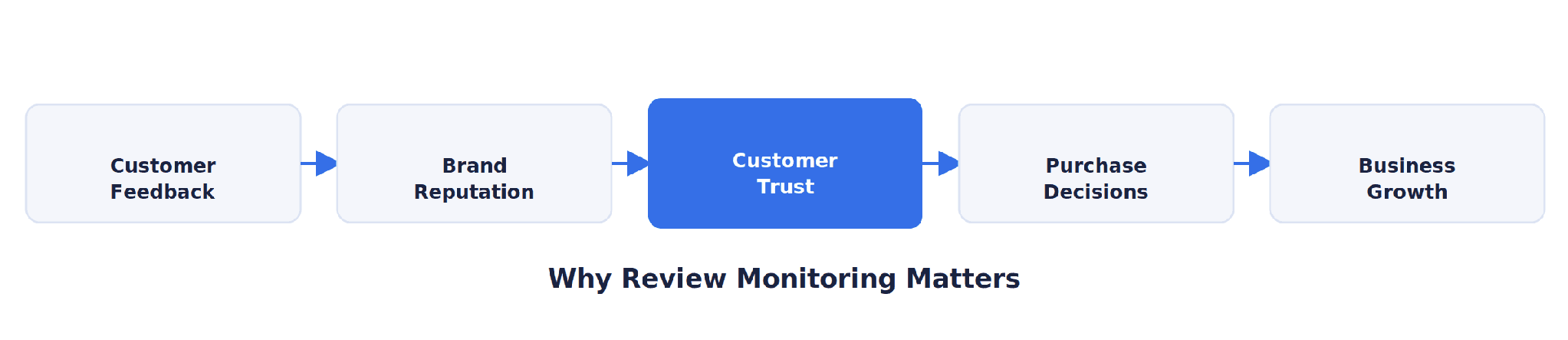
Impact chain: customer feedback → brand reputation → customer trust → purchase decisions → business growth.
Review monitoring matters because reviews now function as a form of public record for a business's reliability, and that record directly shapes buying decisions.
Business implications. Recurring complaints in reviews are often the earliest, cheapest signal a business gets about a product or service issue, well before it shows up in churn numbers or support ticket volume.
Customer implications. Customers increasingly expect businesses to respond to reviews, especially negative ones. A pattern of unanswered complaints signals a business that is not listening, regardless of how good the underlying product is.
Marketing implications. Genuine customer language from reviews is a resource. It reveals the actual words customers use to describe value, which is often more effective in marketing copy than internal messaging.
Reputation implications. Reputation is cumulative. A single bad review rarely changes a buyer's mind, but an unmonitored pattern of similar complaints, left unanswered over months, compounds into a reputation problem that is far harder to reverse than it would have been to address early.
AI search implications. AI-generated answers and recommendations increasingly draw on review content and sentiment when describing a brand. A business with an unmanaged, negative review presence is more likely to be described unfavorably in AI-generated summaries and comparisons, not just in traditional search results.
See here: 6 Reasons Why Online Reviews for Businesses Matter
Review Monitoring vs. Review Management
These two terms are often used interchangeably, but they describe different parts of the same workflow.
Review Monitoring | Review Management |
|---|---|
Tracking and detecting reviews across platforms | Acting on reviews, including responses |
Focused on visibility and pattern detection | Focused on resolution and reputation repair |
Answers: “What are customers saying, and where?” | Answers: “What should we do about it?” |
A continuous, largely automated process | Often a manual, human-led process |
In practice, monitoring is the input and management is the output. A business can monitor reviews without acting on them, but review management is impossible without reliable monitoring feeding it.
What Factors Influence Review Monitoring?
Number of Review Sources
A local single-location business might only need to watch two or three platforms. A multi-location retailer, an app with millions of users, or a B2B software company selling through multiple channels will have review activity spread across many more sources, which increases the complexity of monitoring.
Review Volume
High-volume businesses need monitoring that can surface patterns automatically. At low volume, a person can reasonably read every review. At higher volume, manual reading becomes impractical, and the risk of missing an important trend increases.
Industry Norms
Some industries have review platforms that function as a de facto standard, such as G2 and Capterra for B2B software, or Healthgrades and Zocdoc for healthcare providers. Monitoring needs to reflect where a specific industry's customers actually go to leave feedback, not just the general platforms.
Internal Ownership
Monitoring only works if someone is responsible for reviewing the output. Without clear ownership, even a well-built monitoring setup produces data that nobody consistently reviews or acts on.
How Can Businesses Measure Review Monitoring?
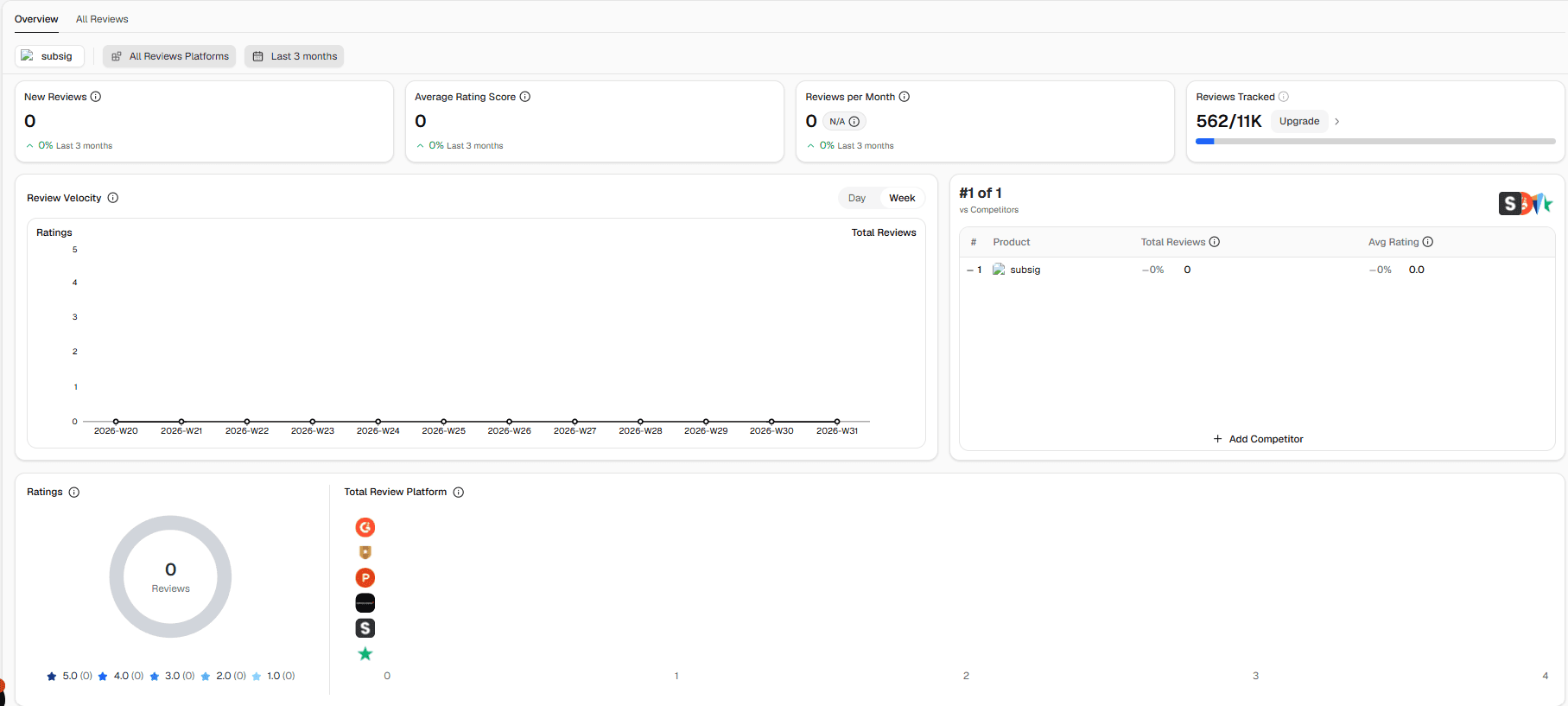
Dashboard view: review volume, average rating, sentiment split, response rate, and platform-by-platform performance.
Effective measurement goes beyond checking a single average star rating. Useful metrics include:
Review volume — how many reviews are coming in, and whether that volume is increasing or decreasing over time.
Average rating, by platform — a blended average can hide a real problem on one specific platform.
Sentiment trend over time — whether the tone of reviews is improving, stable, or declining, independent of the star rating.
Response rate — the percentage of reviews, especially negative ones, that receive a reply.
Response time — how long it takes for a review to be addressed after it is posted.
Recurring themes — the specific issues or praise points that show up across multiple reviews, which matter more than any single review in isolation.
Platform-by-platform performance — reputation often varies by channel; a business might perform well on Google and poorly on a niche industry site that a smaller but influential audience uses.
Tracking these over time, rather than checking them once, is what turns review monitoring into an early warning system instead of a retrospective report.
See here: Tips & Tricks: Online Reputation Management | Brand24
How Can Businesses Improve Review Monitoring?
Consolidate sources first. Before optimizing anything, make sure every relevant review platform is actually being tracked. It is common for businesses to monitor the two or three platforms they know about while missing category-specific ones their customers actually use.
Assign clear ownership. Decide who reviews the monitoring output and who is responsible for responses. Monitoring without ownership becomes a dashboard nobody opens.
Set a response time standard. Even a simple internal rule, such as responding to negative reviews within 48 hours, changes how monitoring gets used day to day.
Route insights to the right team. A recurring product complaint should reach the product team, not just sit in a marketing report. Monitoring is only useful if the output reaches whoever can act on it.
Review trends, not just individual reviews. A single negative review is rarely actionable on its own. A theme that appears across ten reviews over two months usually is.
What Should Businesses Look For in a Review Monitoring Approach?
Coverage
Does the approach track the specific platforms relevant to the business, including industry-specific ones, not just the largest general platforms?
Reporting Quality
Does it surface actionable patterns and trends, or just raw review counts and ratings that still require manual interpretation?
Competitor Comparison
Can the business see how its review volume, rating, and sentiment compare with direct competitors, rather than evaluating its reputation in isolation?
Scalability
Can the approach support additional locations, products, or markets as the business grows, without requiring a manual rebuild each time?
Ease of Use
Will the team actually check it regularly? A technically capable setup that nobody looks at consistently provides little practical value.
Integration With Existing Workflow
Does it fit into how support, product, and marketing teams already work, or does it require an entirely separate process to get value from it?
A related area worth understanding alongside review monitoring is AI visibility monitoring, which tracks how a brand is described and recommended in AI-generated search results and chat responses. Reviews also feed directly into reputation monitoring, since recurring themes and sentiment trends are a core input to how a brand's reputation is scored over time. Together, review monitoring, review management, and reputation monitoring form the core of a business's ongoing reputation workflow.
Final Thoughts
Review monitoring is not about collecting every piece of feedback a business receives. It is about making sure feedback that matters, recurring complaints, meaningful sentiment shifts, and patterns across platforms actually reach someone who can act on it.
The businesses that handle this well are not necessarily the ones with the best reviews. They are the ones that catch problems early, respond consistently, and treat review data as an ongoing signal rather than something to check occasionally. As reviews increasingly shape not just search results but AI-generated brand descriptions, the cost of not monitoring them consistently continues to grow.
The practical next step for most businesses is straightforward: confirm which platforms actually carry review activity relevant to the business, centralize that feedback in one place, and assign someone to own the response process. The specific tools matter less than having that workflow in place.
See How Your Brand's Reviews and Reputation Look in One Place With Subsig
Subsig brings review monitoring together with AI visibility tracking and broader brand monitoring, so businesses can see customer sentiment, recurring feedback themes, and reputation trends across platforms without checking each source separately. If review activity is currently scattered across multiple dashboards or checked inconsistently, that is usually the first sign that a centralized approach would help.
Start your 7-day free trial and build your reputation. No Credit Card required, Plans start at $79.
Related Articles

AI Visibility

on
AI search in 2026: what's changed, and how businesses can adapt
Buyer research has moved onto AI platforms, and classic search clicks keep falling even as visibility grows. Most B2B brands remain invisible across the platforms their buyers now use. Here is what changed in 2026, and what adapting actually requires.

Brand Mention
on
How to choose the right prompts to track your AI visibility
Choosing the right prompts is the first step to tracking AI visibility effectively. Here are the five categories to cover, examples for each, and what a breakdown of visibility, sentiment, ranking, and sources actually reveals.
AI Visibility
on
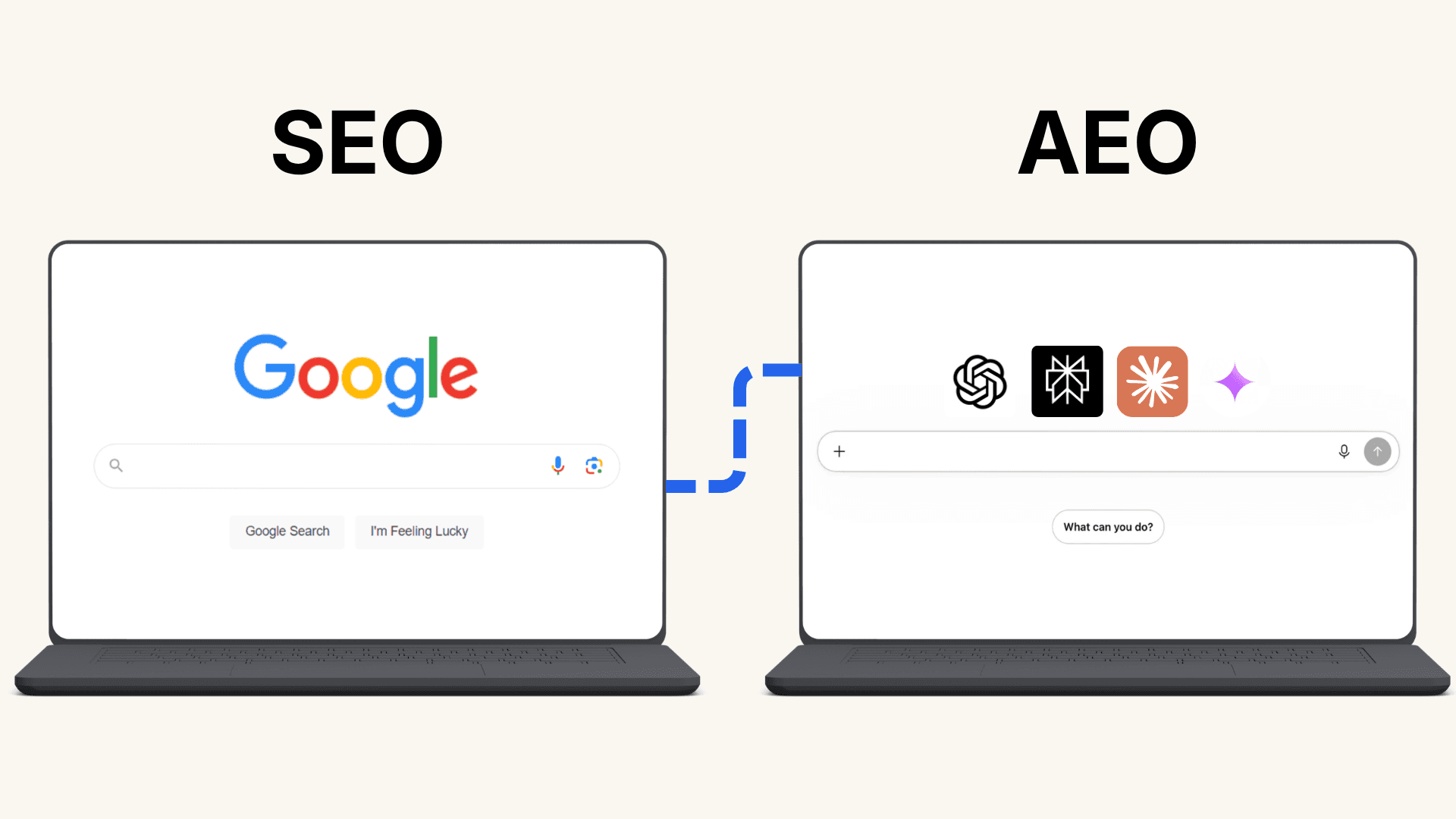
SEO vs AEO: a building block, not a replacement
AEO can feel like a brand-new discipline to learn from scratch, right as clicks from Google search keep dropping. It isn't. AEO is built on the SEO fundamentals already in place, here's how the two actually work together.

AI Visibility
on
How online reviews improve AI visibility: why reviews matter
Online reviews give AI search tools more context about your brand by showing what real customers say about your products or services. Learn how reviews, reputation, and online mentions can support your AI visibility and help AI understand when your brand may be relevant.
AI Visibility
on
AI visibility: AI marketing that reaches decision makers
AI marketing isn't just content and ads anymore, it's how the buying committee actually finds you. Here's who's using ChatGPT, Perplexity, Claude, and Google AI Overview, and why missing even one of them can cost you the sale.

AI Visibility
on
August 2026 ranking dips explained: seasonal trends vs. AI visibility changes
Is your August ranking drop seasonal or AI related? Learn which SEO and AI visibility signals can help you find out.