ChatGPT gives businesses a new way to understand their AI visibility
OpenAI’s Businesses in ChatGPT update gives eligible brands access to business profiles and engagement insights. Learn what the data means and how Subsig can help you identify your next steps.

A potential customer asks ChatGPT for a product recommendation. Your business appears in the answer, they explore your offering, and perhaps they visit your website.
For your marketing team, understanding that journey can be difficult. Which questions brought your business into the conversation? Did the information help someone take the next step?
OpenAI’s introduction of Businesses in ChatGPT gives eligible businesses a new way to investigate part of that journey.
The update introduces Business Hub, where companies can manage business information and access engagement insights. For brands reviewing their AI visibility, it creates a useful starting point for understanding how they appear inside ChatGPT.
Inside OpenAI’s Businesses in ChatGPT update
Businesses in ChatGPT is launching in beta with business claiming, information management, engagement reporting, and optional Business Agents.
Feature | What it does | Why it matters to your business |
|---|---|---|
Business claiming | Lets eligible companies claim their business through Business Hub. | Gives your team a place to manage the information it provides. |
Business information | Supports business details and product feeds with pricing and availability. | Helps customers explore current offerings. |
Engagement insights | Reports mentions, website clicks, and discovery topics, subject to thresholds. | Provides signals your team can investigate. |
Business Agents | Lets customers choose a separate conversation with an eligible business’s agent. | Offers another way to explore products and services. |
Business Agents initially support eligible ecommerce and online service businesses in the United States. Their conversations are clearly labeled and separate from ChatGPT’s independent answers.
The immediate opportunity for marketing teams is to understand what the reporting means and decide which findings deserve attention.
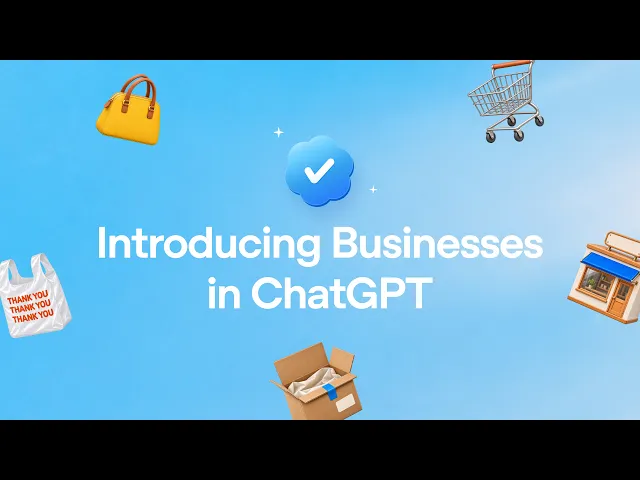
Watch OpenAI introduce Businesses in ChatGPT
Published by OpenAI on November 10, 2026, this announcement video introduces Business Hub, business engagement insights, and Business Agents. It provides a quick overview of the update before we look at what the data means for your business.
Understanding your Business Hub insights
OpenAI’s setup guidance describes aggregate reporting over the past 28 days.
The definitions matter. For an online business, a recorded mention requires ChatGPT to reference its website. Naming the brand alone does not count. Local business mentions use a different definition based on a location result.
Discovery topics group themes. They do not reveal individual prompts, private conversations, or a direct measure of customer intent. Blank metrics can reflect reporting thresholds or unavailable data rather than zero activity.
With those limits in mind, businesses can use the information to guide their next steps.
Align discovery themes with your priority offerings
Consider a hypothetical software company expanding into agency workflows.
If the discovery themes suggest attention around basic task management, the team could investigate whether its agency offering is clearly explained.
That means reviewing how the website presents client approval workflows, reporting features, and customer examples that demonstrate how agencies use the product.
The insight creates a research opportunity. Reviewing the content helps the team decide whether there is a gap worth addressing.
Connect website clicks with customer actions
A website click is an opportunity to help someone move forward.
Review the page visitors reach. They should be able to understand the product, check whether it fits their needs, and find a useful next step.
Connect that review with your own website analytics. Relevant enquiries, trial sign-ups, and purchases provide more business context than clicks alone.
Build a baseline before drawing conclusions
Avoid changing your strategy around a single number.
Record a baseline, keep track of updates, and review patterns over time. If reporting is limited, use it alongside other evidence rather than assuming it represents the whole customer journey.
What you notice | What to investigate | A practical next step |
|---|---|---|
A relevant discovery theme | Whether your website answers questions about that use case. | Improve a page with clear explanations and supporting evidence. |
Website clicks without useful customer actions | Whether the destination page meets visitors’ needs. | Review its content, navigation, and next step. |
An inaccurate description found during answer checks | Whether public information is outdated or inconsistent. | Correct the underlying facts and monitor subsequent answers. |
Limited reporting | Whether there is enough evidence to identify a pattern. | Continue collecting a baseline and compare with other measurements. |
Business claiming as the foundation for ongoing visibility work
OpenAI says claiming a business does not guarantee increased visibility or control over independent recommendations.
Access also depends on eligibility and verification. Claim approval and Persona identity verification are required for insights and publishing information updates. Current guidance limits local stores and restaurants to claiming an existing U.S. listing.
For businesses, the practical response is to make setup part of an ongoing process.
Assign someone to maintain your information. Choose the customer questions that matter most. Review whether the information people find explains your offering accurately and helps them make a decision.
Turn AI visibility insights into action with Subsig
Business Hub adds native reporting about activity within ChatGPT. Businesses may also want to investigate competitor presence, specific buyer questions, and results across other AI platforms.
Subsig connects those questions with measurement and a plan for improvement.
1. Track your brand across relevant AI answers
Subsig’s AI Visibility Tracker helps teams monitor prompts, brand mentions, citations, sentiment, and competitor presence across supported AI platforms.
Start with questions close to a buying decision. A category recommendation, a specific use case, and a competitor comparison can reveal different gaps.
Keep monitored prompt results separate from Business Hub engagement counts. They measure different things and should not be treated as interchangeable.
2. Investigate the sources shaping your brand’s representation
When a competitor appears or your business is described inaccurately, look at the sources.
Review your documentation for clear answers, check whether old product limitations are still being repeated, and identify information missing from comparison pages.
Subsig’s Answer Engine Optimization service includes source mapping, competitor analysis, and work on how AI describes your brand.
That gives your team a more specific task than simply publishing more content.
3. Prioritize improvements based on the gaps
A visibility problem may call for an updated product page, a clearer comparison, or stronger evidence for a particular use case.
Subsig’s methodology connects the assessment with work across website content, genuine customer reviews, communities, and other relevant sources.
The scope should follow the findings. If customers cannot verify an integration, improve the documentation. If outdated information is circulating, make the current facts easier to find and reference.
4. Measure visibility alongside business outcomes
Record what changed and when, then repeat the checks consistently.
Look at how your business is described and whether relevant visitors take useful actions. This helps the team assess progress without assuming that every increase in mentions produces qualified demand.
Build your next AI visibility plan with Subsig
Business Hub gives eligible businesses another source of information about their presence in ChatGPT.
The useful next step is deciding what to investigate. Review whether customers are discovering your priority offerings, check the accuracy of your information, and identify topics that need better explanations.
If your team needs help connecting those findings to a plan, speak with Subsig.
We can help you assess your AI visibility, investigate the gaps, and prioritize improvements across your website and the sources AI answers reference.
Related Articles
AI Visibility

on
ChatGPT gives businesses a new way to understand their AI visibility
OpenAI’s Businesses in ChatGPT update gives eligible brands access to business profiles and engagement insights. Learn what the data means and how Subsig can help you identify your next steps.

Review Monitoring
on
G2 unites four software marketplaces in its biggest seller experience update
G2 has unified review collection across G2, Capterra, Software Advice, and GetApp. Here’s what changes for software brands and how Subsig can help.

Reddit Marketing
on
2026 Reddit updates: what they mean for your brand’s AI visibility
Explore Reddit’s 2026 search and feed updates, their implications for brand AI visibility, and how Subsig connects community engagement with measurement.

AI Visibility
on
Stop chasing clicks and start winning AI visibility
Discover why AI visibility is becoming the new measure of brand discoverability and how to make your brand stand out in AI powered search.

AI Visibility
on
AI visibility score: what makes AI recommend your brand?
Learn what influences your AI visibility score and how Subsig helps brands track mentions, compare competitors, and improve AI search visibility.

AI Visibility
on
How Google AI search is changing SEO and website traffic
Learn how Google AI search affects website traffic, what it means for SEO, and how businesses can improve visibility in AI-generated answers.